The 50-metre backstroke is one of swimming’s most demanding sprint events, requiring swimmers to maximise power and technique whilst navigating backwards through the water at breakneck speed. Unlike longer backstroke distances where pacing matters, this sprint gives athletes just one length to unleash everything they’ve trained for.
Training for the 50m backstroke sprint requires a focused approach that combines explosive starts, powerful underwater dolphin kicks, high stroke rates, and precise finishing technique to shave crucial tenths of seconds off race times. Success in this event depends on perfecting each phase of the race, from the moment swimmers grip the starting blocks to their final touch at the wall.
This comprehensive training guide explores the specific techniques and training methods needed for backstroke sprinting, covering everything from building explosive power off the blocks to maintaining stroke efficiency at maximum speed. Swimmers will discover targeted drills, strength training protocols, and race strategy elements that separate good sprinters from great ones in this technically challenging event.
Foundations of Sprint Backstroke Technique
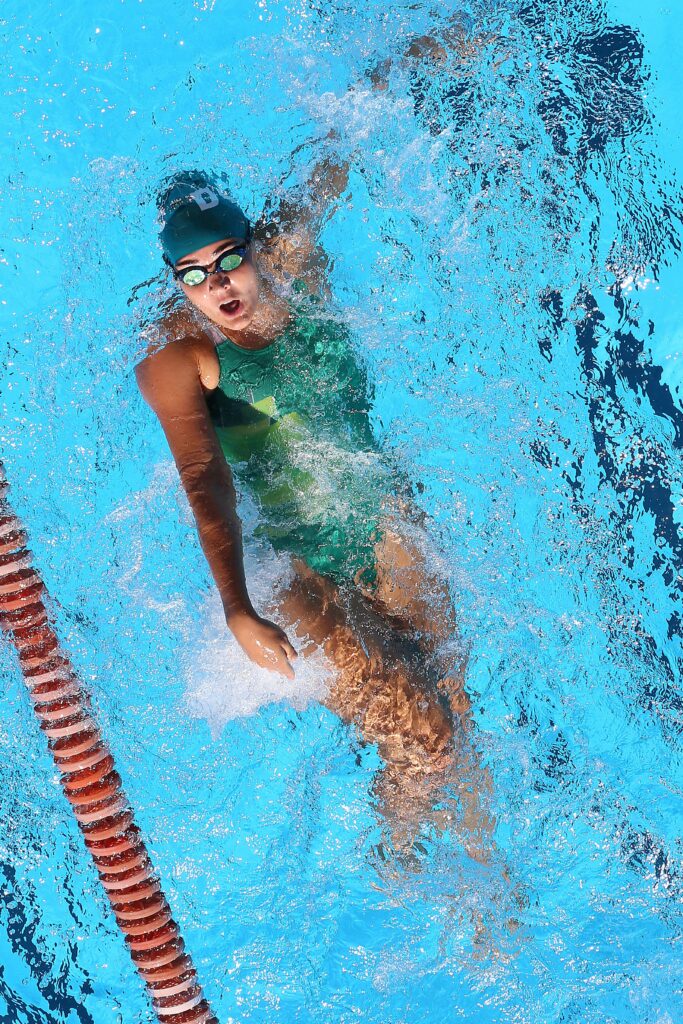
Sprint backstroke requires explosive power, precise technique, and maximum efficiency over just 50 metres. The key differences lie in maintaining a higher body position, increasing stroke rate significantly, and optimising arm recovery patterns for speed rather than endurance.
Unique Aspects of the 50m Backstroke Sprint
The 50m backstroke sprint demands different technical approaches compared to longer distances. Swimmers must prioritise speed over energy conservation throughout the entire race.
Sprint vs Distance Comparison:
- Stroke rate: 35-45 strokes per minute (sprint) vs 28-35 (distance)
- Breathing: Minimal breathing to reduce drag
- Kick intensity: Continuous powerful kicks vs rhythmic energy-saving kicks
The race allows no time for pacing strategies. Every stroke must generate maximum propulsion from start to finish.
Sprint backstrokers maintain higher stroke rates without sacrificing technique quality. This requires exceptional conditioning and precise motor control.
The underwater dolphin kick phase becomes crucial, with swimmers maximising the 15-metre limit off each wall.
Body Position for Maximum Speed
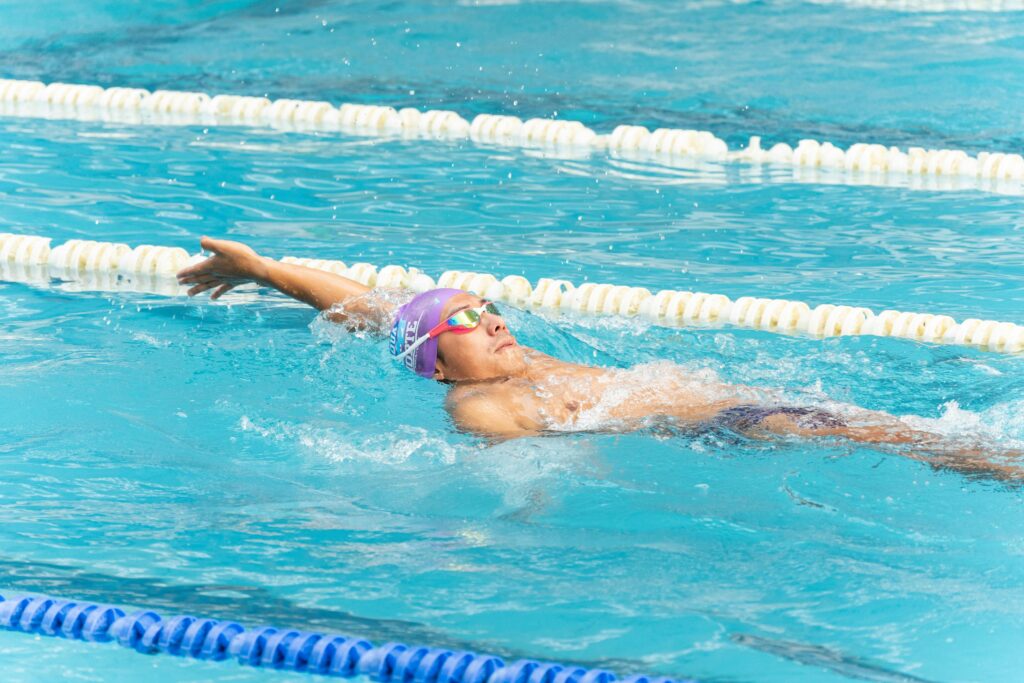
Optimal body position in sprint backstroke involves riding higher on the water surface than distance swimming. The hips sit closer to the surface, creating less frontal resistance.
Key positioning elements:
- Head: Steady with ears just underwater
- Hips: High and stable near surface
- Core: Tight engagement preventing excessive rotation
- Legs: Continuous fast kicks with minimal knee bend
The body maintains a slight downhill angle from hips to feet. This position allows for more aggressive catch phases and higher stroke rates.
Swimmers avoid excessive body roll, keeping rotation between 30-45 degrees per side. Too much rotation slows the stroke rate needed for sprinting.
The streamline position during starts and turns becomes even more critical. A tight, narrow body profile reduces drag during the fastest underwater phases.
Backstroke Stroke Rate and Arm Recovery
Sprint backstroke requires significantly higher stroke rates whilst maintaining efficient arm recovery patterns. The arms must move quickly without creating unnecessary drag or reducing power.
Arm recovery technique:
- Exit: Clean lift with little finger leading
- Recovery: Straight arm path directly over shoulder
- Entry: Hand enters at shoulder width, thumb first
- Timing: Overlapping arm cycles for continuous propulsion
The catch phase becomes shorter and more direct. Swimmers focus on immediate water grip rather than extended reaching motions used in distance events.
Stroke rates typically increase by 15-25% compared to 200m pace. This demands exceptional fitness and neuromuscular coordination to maintain technique under fatigue.
The pull pattern stays close to the body centreline. Wide sweeping motions waste energy and reduce the stroke rate potential needed for optimal sprint performance.
Optimising the Explosive Start
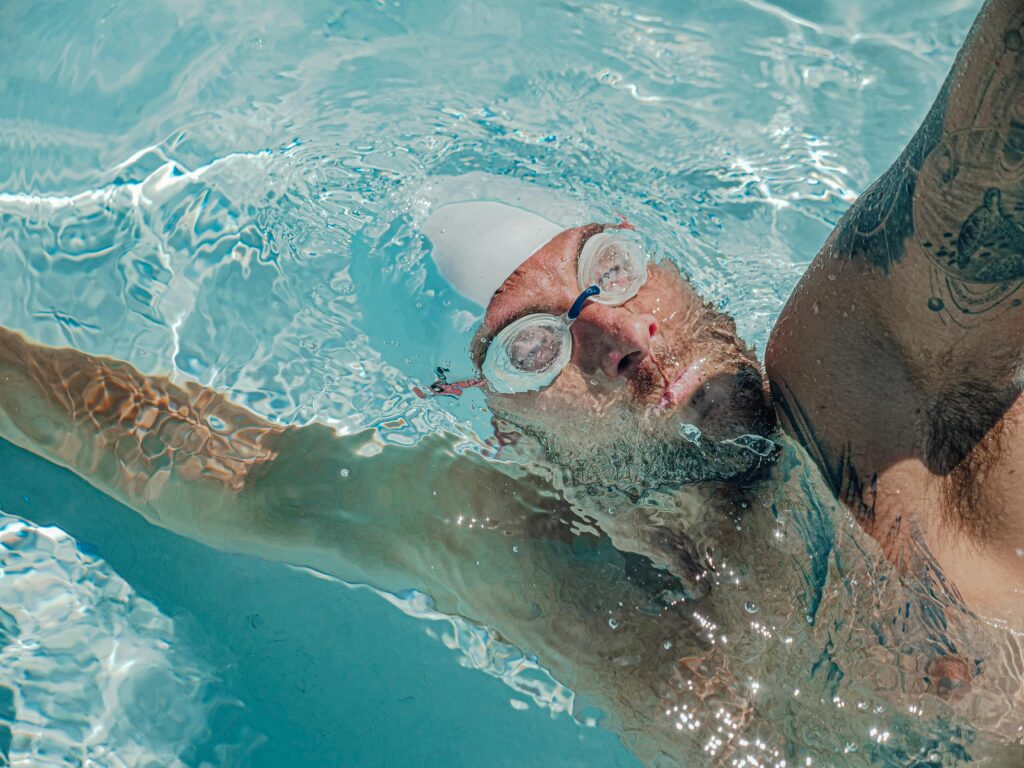
The backstroke start requires precise positioning and explosive power to maximise propulsion from the wall. Backstroke start techniques focus on wall contact, body alignment, and seamless transition to the underwater phase for optimal race performance.
Start Position and Execution
Swimmers should position their feet on the wedge with toes gripping the wall surface. The hands grasp the starting grips with fingers pointing downward. This creates a stable platform for explosive force generation.
The body maintains a tucked position with knees bent at approximately 90 degrees. The head stays in a neutral position between the arms. This compact stance allows for maximum power transfer during the push-off phase.
Key positioning elements:
- Feet shoulder-width apart on the wedge
- Equal weight distribution between both feet
- Shoulders directly above the hands
- Core muscles engaged for stability
Upon the starting signal, swimmers drive powerfully through their legs whilst simultaneously releasing the grips. The push-off generates both horizontal and vertical force components. Research shows that swimmers’ effective actions during the backstroke start contribute approximately 40% of total force through structural positioning.
The take-off angle should be around 20 degrees to the horizontal. This angle maximises flight distance whilst ensuring proper water entry position.
Transition from Start to Underwater Phase
The flight phase requires swimmers to extend their body into a streamlined position. Arms reach overhead with hands overlapped. The body forms a straight line from fingertips to toes.
Water entry occurs with hands first, followed by the head and body. The entry should be clean with minimal splash. A smooth entry reduces drag and maintains forward momentum.
Critical transition points:
- Body extension: Complete within 0.3 seconds of take-off
- Hand position: Overlapped with palms facing down
- Entry angle: Shallow to maintain speed
Once underwater, swimmers immediately begin dolphin kicks whilst maintaining the streamlined position. The underwater phase allows for speeds faster than surface swimming. Swimmers can travel up to 15 metres underwater before surfacing.
The transition to surface swimming requires precise timing. Swimmers should begin their first stroke just before breaking the surface. This maintains momentum and prevents speed loss during the critical early race phase.
Mastering the Underwater Section
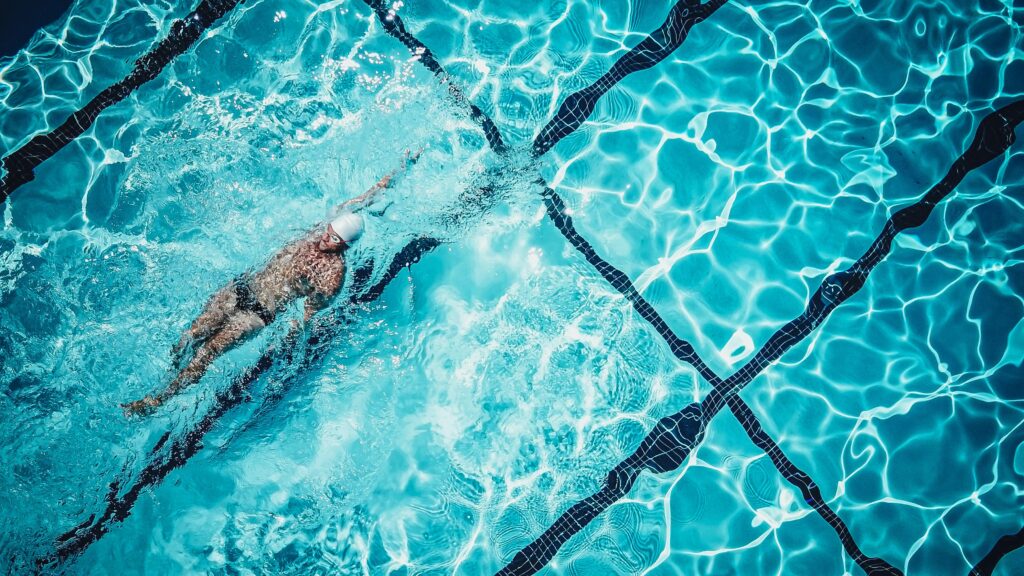
The underwater phase represents the fastest part of any backstroke sprint, making it crucial for race success. Proper dolphin kick technique and precise breakout timing can determine whether a swimmer gains or loses valuable time.
Effective Underwater Dolphin Kicks
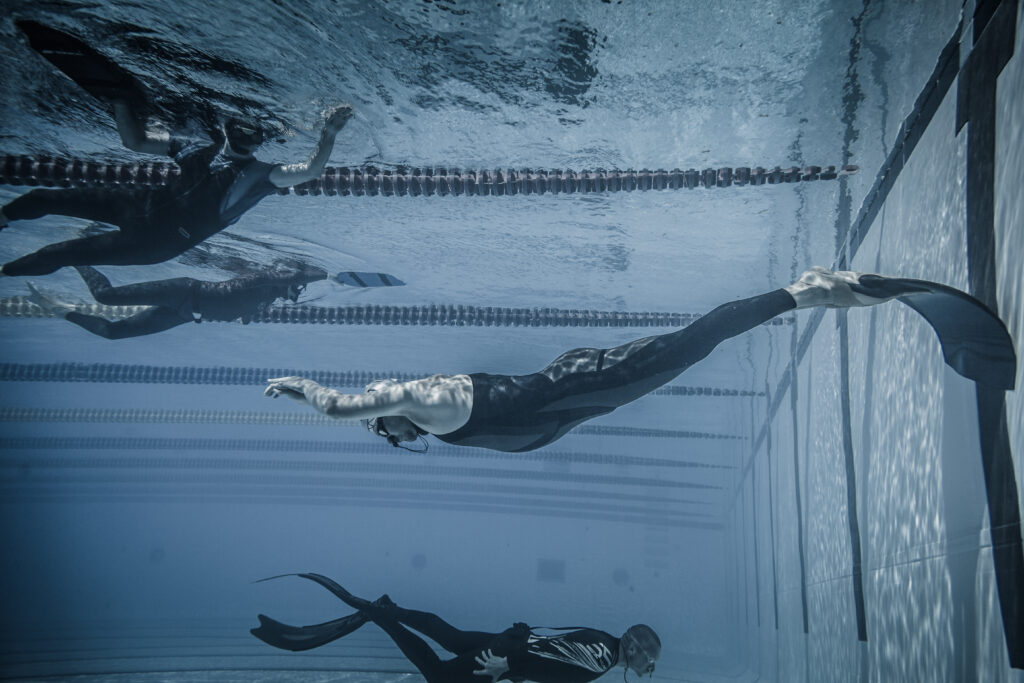
The underwater dolphin kicks form the foundation of backstroke sprint performance. Swimmers should execute 6-12 kicks within the legal 15-metre limit, depending on their individual strength and technique.
Body position remains critical during this phase. Athletes must maintain a tight streamline position with arms extended overhead and core fully engaged. The kick motion should originate from the hips and core rather than just the knees.
Kick rhythm requires careful attention. Fast, small kicks often prove more effective than large, powerful movements that create excessive drag. The underwater phase can be the fastest part of the race when executed properly.
Swimmers should practice counting kicks during training sessions. This creates muscle memory that becomes automatic during competition when adrenaline runs high.
Breakout Timing into Surface Swimming
The transition from underwater kicks to surface swimming demands precise timing. Swimmers must surface without losing the speed they’ve built underwater.
Breakout depth typically occurs 12-15 metres from the wall. Athletes should begin their transition whilst still moving faster than their surface swimming speed. This prevents the common mistake of staying underwater too long and surfacing whilst decelerating.
The first stroke after breakout must be powerful and controlled. Swimmers should avoid taking a weak stroke that disrupts their rhythm. The explosive underwater phase should flow seamlessly into high-tempo surface swimming.
Head position during breakout affects the entire transition. Athletes must keep their head aligned with their spine, avoiding lifting too quickly which creates drag and disrupts body position.
Stroke Efficiency and Speed Maintenance
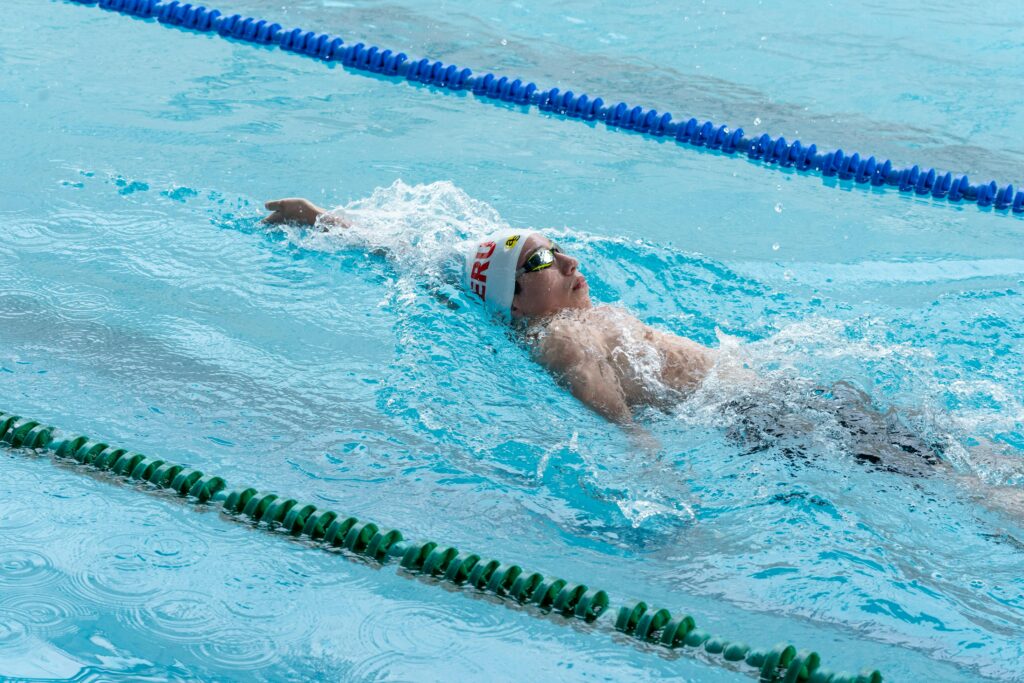
Swimmers must balance maximum stroke rate with proper technique to avoid creating drag that slows them down. The flutter kick provides continuous propulsion whilst maintaining body position throughout the entire 50m sprint.
Maintaining Technique at High Stroke Rate
Sprint backstroke requires explosive starts and high stroke rates without sacrificing proper form. Swimmers who focus solely on speed often develop inefficient movement patterns that create resistance.
Key technique points at high stroke rates:
- Keep hand entry near shoulder width
- Maintain high elbow catch position
- Drive water straight backwards, not outwards
- Avoid excessive lateral arm movement
The stroke rate should increase through shorter, quicker pulls rather than longer strokes. Swimmers need to maintain their catch phase strength even when moving faster.
Training with a tempo trainer helps maintain stroke rate whilst keeping technique intact. This device sets a specific rhythm that prevents swimmers from rushing their movements.
Body position becomes critical at higher speeds. The swimmer should stay higher on the water with minimal drag rather than sitting too deep.
Optimising Flutter Kick
The flutter kick provides continuous thrust and maintains proper body alignment during sprint events. Most sprint backstrokers use a six-beat kick pattern with six kicks per arm cycle.
Effective flutter kick characteristics:
- Quick, compact movements from the hips
- Minimal knee bend to reduce drag
- Consistent rhythm throughout the race
- Strong core engagement for stability
The kick should remain powerful and fast rather than deep and slow. Swimmers generate more speed through rapid leg turnover than large kicking movements.
Proper ankle flexibility allows the feet to act like fins, capturing more water with each kick. Stiff ankles reduce the kick’s effectiveness and waste energy.
The kick must continue strongly through turns and finishes. Many swimmers let their kick weaken in the final metres, losing valuable speed when it matters most.
Backstroke Drills for Sprint Improvement
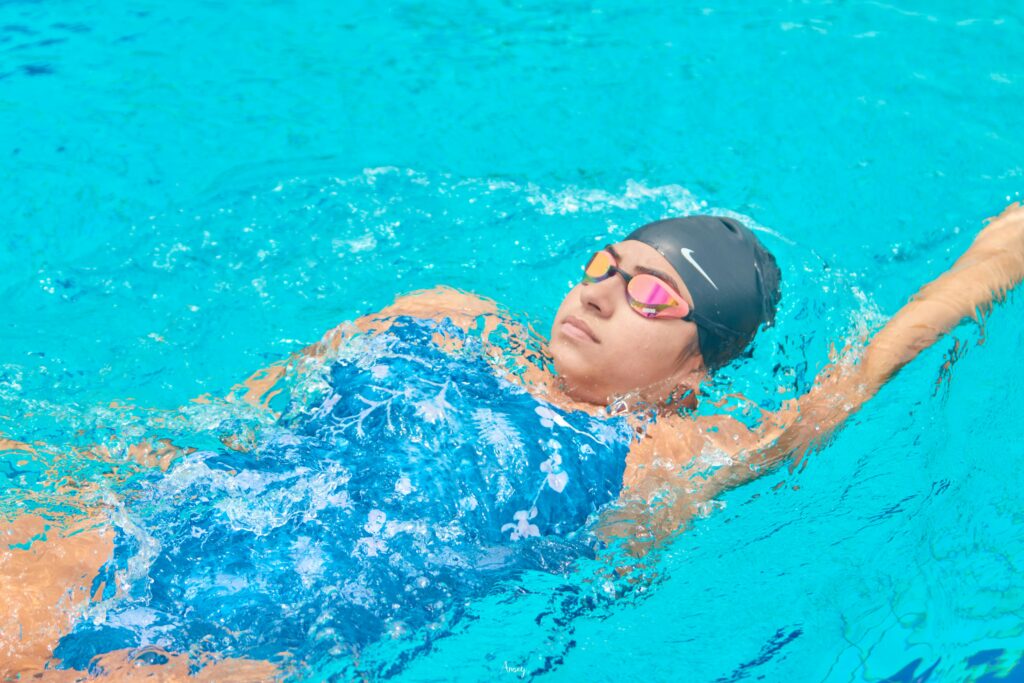
Specific backstroke drills target speed development and underwater technique refinement. These focused exercises build explosive power whilst maintaining proper stroke mechanics for maximum sprint performance.
Recommended Drills for Speed and Form
Double arm backstroke reduces rotation and forces swimmers to develop a more shallow, powerful pull. This drill builds strength in the lats and back muscles essential for sprint speed.
Single Arm Backstroke improves stroke tempo and body position. Swimmers alternate between right arm only and left arm only whilst maintaining steady kick rhythm. This drill helps identify stroke imbalances that slow sprint times.
Six-Beat Kick Drill develops the flutter kick intensity needed for 50m races. Swimmers perform backstroke with exaggerated six-beat kick pattern, focusing on small, fast movements from the hips rather than the knees.
Sprint Tempo Sets combine technique with race pace training:
- 4 x 25m at maximum stroke rate
- Focus on clean hand entry
- Maintain flat body position
- Keep head still and aligned
Drills to Enhance Underwater Phase
Streamline Push-offs develop the explosive start needed for sprint backstroke. Swimmers practice tight core engagement and proper body alignment during the crucial first few metres underwater.
Dolphin Kick Progression builds the 6-12 kicks essential for maximising the underwater phase. Swimmers begin with short bursts, gradually extending distance whilst maintaining speed.
Breakout Timing Drills perfect the transition from underwater to surface swimming. Swimmers count kicks during practice to make breakout automatic during races.
15m Sprint Kicks utilise the full legal underwater distance:
- Start with explosive push-off
- Maintain narrow streamline position
- Focus on core-driven kicks
- Time breakout for maximum speed retention
Finishing the 50m Backstroke Strong
The final metres of a 50m backstroke determine race outcomes through precise stroke counting and proper wall contact technique. Swimmers must master their approach distance and execute a full-extension finish to maximise their speed through the touch.
Stroke Counting and Approach
Stroke counting becomes critical in the final phase of a 50m backstroke sprint. Most swimmers take 5-7 strokes from the backstroke flags to the wall.
Swimmers should establish their personal stroke count during training. This number varies based on height, stroke length, and pool conditions. Counting must become automatic under race pressure.
The approach requires maintaining stroke rate rather than lengthening strokes. Gliding reduces speed significantly in sprint events. Each stroke should maintain the same tempo established during the race.
Key approach elements:
- Count strokes consistently from the flags
- Maintain high stroke rate
- Avoid gliding or changing rhythm
- Keep head position stable
Swimmers who rush their count often finish short of the wall. Those who hesitate lose valuable time. Practice makes this timing instinctive.
Final Stroke and Wall Touch Technique
The perfect finish technique requires full arm extension at wall contact. Swimmers should drive their final stroke with maximum force rather than easing into the touch.
Proper finishing position includes a straight wrist and extended shoulder. The hand should hit the wall with fingers pointing upward. This position ensures legal contact whilst maintaining speed.
Timing the final stroke prevents mid-stroke wall contact. Swimmers should complete their stroke cycle so the leading hand reaches full extension at the wall. Premature or delayed timing costs crucial hundredths.
Finishing checklist:
- Full arm extension
- Straight wrist position
- Fingers pointing up
- Complete stroke cycle
- Maintain body alignment
Head position remains neutral throughout the finish. Looking for the wall disrupts body position and creates drag. Trust the stroke count and commit to the final movement.
Supporting Elements: Strength, Recovery, and Mindset
Sprint backstroke success extends beyond pool training to include targeted strength work and mental preparation. These elements work together to create the power and focus needed for peak 50m performance.
Strength and Conditioning for Sprint Backstroke
Upper body strength plays a critical role in swimming performance, particularly for backstrokers who rely heavily on their pulling power. Pull-ups and lat pulldowns build the back muscles essential for generating speed through the water.
Backstrokers need specific strength training that targets their unique movement patterns. Focus on exercises that strengthen the posterior chain including the lats, rhomboids, and rear deltoids.
Key Strength Exercises:
- Pull-ups (weighted progression)
- Single-arm dumbbell rows
- Band pull-aparts
- Reverse flies
- Core rotational exercises
Plyometric training develops the explosive power needed for starts and high stroke rates. Box jumps, medicine ball throws, and resistance band sprints translate directly to faster swimming.
Athletic power development involves strength training, plyometrics, and sport-specific drills. Recovery between strength sessions allows muscles to adapt and grow stronger.
Mental Preparation and Sprint Focus
Sprint backstroke demands complete mental commitment from the first stroke to the wall touch. Backstrokers must develop confidence in their race plan and execute it without hesitation.
Developing a sprinter mindset starts in practice with short, intense efforts. Swimmers should visualise their entire 50m race multiple times before competition.
Mental preparation includes stroke counting from the flags and breathing strategies. Backstrokers who practice these elements during training perform them automatically during races.
Mental Training Techniques:
- Race visualisation sessions
- Stroke counting practice
- Breathing pattern rehearsal
- Start sequence mental rehearsal
Confidence builds through consistent backstroke training and successful practice performances. Swimmers who trust their preparation swim faster when it matters most.
Frequently Asked Questions
Sprint backstroke training involves specific techniques for starts, underwater phases, stroke mechanics, and race strategy. Swimmers need targeted exercises and structured training sets to develop the explosive power and technical precision required for 50-metre events.
What exercises can improve sprint speed in 50m backstroke swimming?
Swimmers should focus on explosive starts with strong grip and high hips on the starting blocks. Aggressive arm throws and powerful hip extensions during takeoff create the foundation for fast race times.
Underwater dolphin kick training is essential. Swimmers need 6-12 dolphin kicks within the legal 15-metre limit after the start. The kicks should originate from the core and hips rather than just the knees.
Hypoxic training builds the capacity for limited breathing during races. Many elite swimmers complete 50-metre backstroke events without taking any breaths at all.
Sprint-specific dryland exercises include lat pulldowns, resistance band work for stroke simulation, and core strengthening. These exercises develop the muscle groups used during high-intensity backstroke swimming.
How should beginners approach backstroke technique to increase sprinting efficiency?
Beginners must first master proper body position before attempting sprint speeds. The head should remain still and aligned with the spine throughout the stroke cycle.
A flat body position reduces drag significantly. Swimmers should engage their core muscles to maintain horizontal alignment in the water.
The stroke technique requires controlled turnover rather than frantic arm movement. Clean hand entry without crossing over the midline maintains efficiency at higher stroke rates.
Beginners should practise stroke counting from the backstroke flags. Most swimmers need 5-7 strokes to reach the wall from the flags position.
What are some effective sprint sets for age-group swimmers to enhance 50m backstroke performance?
A proven training set includes 4 x 25-metre backstroke sprints at 40-second intervals. Odd repetitions focus on no breathing with maximum breakout distance. Even repetitions emphasise one breath with perfect finish timing.
Another effective set uses 3 x 50-metre backstroke swims at 90-second intervals. These simulate race conditions with full starts, breakouts, and stroke counting practice.
Underwater kick sets develop crucial speed. Swimmers can perform 4 x 12.5-metre underwater dolphin kicks at 30-second intervals. The goal is explosive push-offs combined with breakout speed.
Mixed distance sets help build both speed and endurance. Training might include 8 x 25 metres alternating between all-out sprints and controlled pace swims.
What is the correct body position for maximising speed in backstroke?
The body should maintain a horizontal position with minimal vertical movement. Excessive hip drop creates drag and reduces forward momentum significantly.
Head position remains neutral with ears underwater and eyes looking upward. Moving the head during the stroke disrupts body alignment and slows swimming speed.
The core muscles must stay engaged throughout the race. A strong core connection prevents the body from breaking at the waist during high-intensity swimming.
Shoulder rotation drives the stroke while the hips remain stable. The rotating shoulders generate power whilst maintaining the streamlined body position necessary for speed.
How can competitive swimmers structure their training sets for sprint swimming?
Training periodisation should peak for major competitions. Swimmers typically reduce volume whilst maintaining intensity during taper periods before important meets.
Weekly structure might include three high-intensity sessions focusing on starts, turns, and race pace swimming. Two additional sessions can develop aerobic base and technique refinement.
Race simulation sets recreate competition conditions. These include full warm-up protocols, practice starts, and time trials with proper rest intervals between efforts.
Technical work should complement speed training. Swimmers benefit from video analysis and stroke rate monitoring to optimise their technique at racing speeds.
What are the benefits of focusing on backstroke in sprint swimming training?
Backstroke develops unique muscle groups compared to other strokes. The pulling pattern strengthens the latissimus dorsi and posterior deltoids effectively.
Sprint backstroke training emphasises explosive starts and underwater skills that transfer to other swimming events. These abilities improve overall racing performance across multiple strokes.
The breathing pattern in backstroke allows for continuous oxygen intake during longer training sets. This advantage helps swimmers maintain higher training intensities for extended periods.
Backstroke technique work improves body awareness and spatial orientation in the water. These skills enhance overall swimming ability and water confidence for competitive athletes.