The 1500m freestyle represents one of swimming’s most demanding endurance challenges, requiring swimmers to maintain speed whilst managing energy reserves over 30 laps of the pool. Unlike shorter sprints where swimmers can rely on pure power, this distance demands careful strategic planning to avoid early fatigue that could derail an entire race performance.
Elite swimmers achieve optimal 1500m freestyle performance by following a parabolic pacing pattern: swimming the first lap at 107-108% of average race velocity, maintaining a steady pace close to 100% of average velocity through the middle section, and finishing with an end spurt in the final laps. Research from World Championships analysis between 2003 and 2019 confirms that medal winners consistently employ this U-shaped velocity curve rather than attempting to maintain constant speed throughout the race.
Understanding proper pacing techniques can transform a swimmer’s approach to this gruelling event, helping them distribute effort effectively whilst building the tactical awareness needed for competitive success. The following guidance explores the scientific principles behind optimal race strategy, practical execution methods, and training approaches that support consistent 1500m freestyle performance at every competitive level.
Understanding the 1500m Freestyle Event
The 1500m freestyle stands as swimming’s premier distance event, combining raw endurance with tactical precision over 30 lengths of a 50-metre pool. Elite swimmers must master both physical demands and strategic pacing to excel in competitions ranging from FINA World Championships to Olympic Games.
Race Structure and Distances
The 1500m freestyle consists of 30 lengths in a standard 50-metre pool. Swimmers complete the race entirely in individual lanes, eliminating the positional battles common in running or cycling events.
Each length represents a 50-metre segment where swimmers must execute turns at both ends. The race structure allows for precise split-time analysis, with pacing strategies typically following a parabolic pattern throughout the distance.
Elite male swimmers complete the event in approximately 14-16 minutes, whilst female swimmers typically finish in 15-17 minutes. The race demands sustained aerobic output whilst maintaining technical precision over the extended duration.
Unlike shorter sprint events, the 1500m provides swimmers ample opportunity to adjust their pace. This distance requires careful energy management to avoid premature fatigue whilst maintaining competitive positioning.
Role in Competitive Swimming
The 1500m freestyle serves as the ultimate test of swimming endurance in competitive pools. Swimming competitions feature this event as the longest pool-based distance, distinguishing it from open-water marathon swimming.
Elite swimmers specialising in distance events often focus their training around 1500m pacing strategies. The event bridges middle-distance racing with pure endurance, requiring athletes to develop both speed and stamina.
Men’s 1500m freestyle appears in major championships including Olympics and World Championships. Women’s 1500m was historically less prominent but gained Olympic status in 2021, equalising distance opportunities across genders.
The event influences training methodologies across competitive swimming programmes. Coaches use 1500m preparation to develop aerobic capacity and pacing discipline in athletes across multiple distances.
Major Competitions and Records
FINA World Championships have featured the 1500m freestyle since 1973 for men and 2001 for women. These competitions provide the most comprehensive data on elite pacing strategies and performance analysis.
The current world records stand at 14:31.02 for men (Sun Yang, 2012) and 15:20.48 for women (Katie Ledecky, 2018). These times represent the pinnacle of distance swimming performance.
FINA oversees technical regulations including pool specifications, timing systems, and stroke legality. World Championships occur biennially, providing regular benchmarks for elite swimmer development.
Major competitions reveal consistent pacing patterns amongst medallists. Research shows that winning performances rely more on superior average race velocity than unique pacing profiles compared to other finalists.
Fundamentals of Pacing in 1500m Freestyle
Pacing in distance swimming requires precise energy management across multiple laps, with the 1500m demanding a specific approach that balances speed with endurance. Understanding these fundamentals helps swimmers develop effective race strategies that maximise performance whilst avoiding premature fatigue.
What is Pacing in Distance Swimming?
Pacing refers to how swimmers distribute their energy and speed throughout a race. In distance swimming, this becomes crucial as swimmers must complete multiple laps without burning out early.
Research on elite 1500m swimmers shows that pacing profiles follow a parabolic or U-shaped curve. This pattern includes three distinct phases: fast start, steady middle section, and strong finish.
The first lap typically sees swimmers reach 107-108% of their average race velocity. They then settle into a consistent pace close to 100% of average velocity through the middle distance.
The final laps involve an “end spurt” where swimmers increase velocity to 104-106% of mean race pace. This strategy allows swimmers to utilise available energy resources effectively whilst maintaining competitive positioning.
Why Pacing is Critical for Performance
Swimming performance depends heavily on energy management due to water’s resistive properties. Poor pacing can lead to significant time losses and compromised race results.
Unlike shorter events such as 50m races that last 20-35 seconds, the 1500m takes 14-16 minutes at elite level. This extended duration means swimmers must carefully manage their physiological resources to avoid premature fatigue.
Studies indicate that optimising pacing could potentially reduce race times by approximately 1.4%. Winners consistently demonstrate superior average race velocity rather than dramatically different pacing profiles compared to other finalists.
The margin between winning and losing often comes down to hundredths of seconds. Effective pacing ensures swimmers have sufficient energy reserves for crucial moments whilst maintaining competitive speed throughout.
Difference Between 1500m and Other Distances
The 1500m requires a unique pacing approach compared to other swimming distances. Shorter events like 200m and 400m freestyle allow for more aggressive early pacing strategies.
In 400m races, swimmers can afford higher intensity early on. The 1500m demands greater restraint during opening laps to preserve energy for the lengthy middle section.
Elite swimmers demonstrate remarkably consistent lap-to-lap variability regardless of final position. This consistency becomes more critical in longer distances where small pacing errors compound over time.
The 1500m also differs from sprint events where pacing has minimal impact. The extended duration means every strategic decision affects the final outcome significantly.
Open water events require different considerations including environmental factors, but pool-based 1500m races allow for more predictable pacing strategies due to controlled conditions.
Core Pacing Strategies for 1500m Freestyle
Elite swimmers employ distinct pacing strategies that determine how they distribute energy across the 30-lap race. The most successful approaches involve either maintaining consistent speed throughout the middle section or strategically varying pace to maximise performance.
Parabolic and U-Shaped Pacing
Elite 1500m swimmers typically follow a parabolic pacing pattern that creates a U-shaped curve when plotting velocity across the race. This strategy involves swimming at the highest speeds during the opening and closing laps.
Swimmers begin the first lap at approximately 107-108% of their average race velocity. They then settle into a steady rhythm through the middle section, maintaining pace close to 100% of their mean velocity.
The final two laps see another surge above average pace. Swimmers typically finish between 104-106% of their mean velocity in the last 50m.
This approach allows swimmers to establish position early whilst conserving energy for a strong finish. Research shows this pattern remains consistent across all finishing positions at World Championship level.
The key advantage lies in tactical positioning. Fast starts prevent swimmers from being boxed in by competitors. Strong finishes help maintain or improve final placement when races tighten.
Even Pace Approach
Even pacing involves maintaining consistent split times throughout the entire race distance. Swimmers aim to complete each 50m lap within a narrow time range, typically varying by less than 1-2 seconds.
This strategy requires exceptional pacing discipline. Swimmers must resist the urge to follow faster competitors early in the race. They also need mental strength to maintain pace when feeling fresh.
Benefits of even pacing:
- Optimal energy distribution
- Reduced risk of premature fatigue
- Consistent oxygen consumption
- Better metabolic efficiency
Drawbacks include:
- Difficulty responding to tactical moves
- Potential for being left behind in fast-starting fields
- Less flexibility for race conditions
Successful even-pace swimmers often rely on superior conditioning rather than tactical positioning. They trust their fitness to outlast competitors who start aggressively.
Negative and Positive Split Tactics
Split tactics refer to how swimmers divide their race into two equal halves. A negative split means swimming the second 750m faster than the first. A positive split involves completing the first half quicker.
Negative splits suit swimmers with excellent endurance bases. They conserve energy early, then gradually increase pace. This approach works well in championship finals where positioning matters less than time.
The strategy requires patience and confidence. Swimmers must trust they can make up ground in the second half when competitors begin to fade.
Positive splits involve faster opening pace followed by slight deceleration. World Championship data shows most elite swimmers employ small positive splits, typically 0-3 seconds difference between halves.
This approach suits swimmers with natural speed who prefer leading from the front. It also works when qualifying standards require aggressive early pacing.
All-Out and J-Shaped Strategies
All-out pacing involves maximum effort from the start, maintaining the highest sustainable pace throughout. This high-risk strategy suits shorter pool competitions or qualifying situations requiring specific times.
Swimmers using all-out pacing typically achieve their fastest possible split times early. They then attempt to minimise pace decline through superior conditioning and mental toughness.
J-shaped pacing creates an inverted curve where swimmers start conservatively, build through the middle section, then finish strongly. This pattern suits swimmers with exceptional closing speed.
The strategy involves swimming slightly below race pace for the first 400-500m. Swimmers then gradually increase velocity through the middle 500-600m before unleashing their strongest pace in the final 400-500m.
J-shaped pacing requires precise timing and exceptional race awareness. Swimmers must judge exactly when to begin their build phase without leaving their move too late.
This approach works particularly well in tactical races where early pace is conservative. It also suits swimmers recovering from injury who need to build confidence gradually.
Practical Race Planning and Execution
Successful 1500m freestyle racing requires precise split time targets, proven elite strategies, and real-time pace monitoring. These three elements form the foundation for executing an effective race plan that maximises performance whilst managing energy efficiently.
Setting Personal Target Splits
Swimmers must establish specific split times based on their personal best performances and current fitness level. The most effective approach involves working backwards from a realistic goal time to determine 100m or 200m interval targets.
Target Split Calculation:
- Divide goal time by 15 (for 100m splits) or by 7.5 (for 200m splits)
- Add 2-3% to middle section splits to account for the parabolic pacing pattern
- Subtract 2-3% from opening and closing splits
Elite swimmers typically aim for their first 100m to be 6-8% faster than average race pace. The middle 1300m should stay within 1-2% of average pace. The final 100m should be 4-6% faster than average pace.
Swimmers should use time calculation tools to plan race strategy by inputting target pace and distance. This transforms vague goals into concrete, measurable objectives that can guide training and competition.
Adapting Elite Swimmers’ Tactics
Research shows that World Championship finalists follow similar pacing profiles regardless of final position. All elite swimmers use a parabolic pacing pattern with three distinct phases.
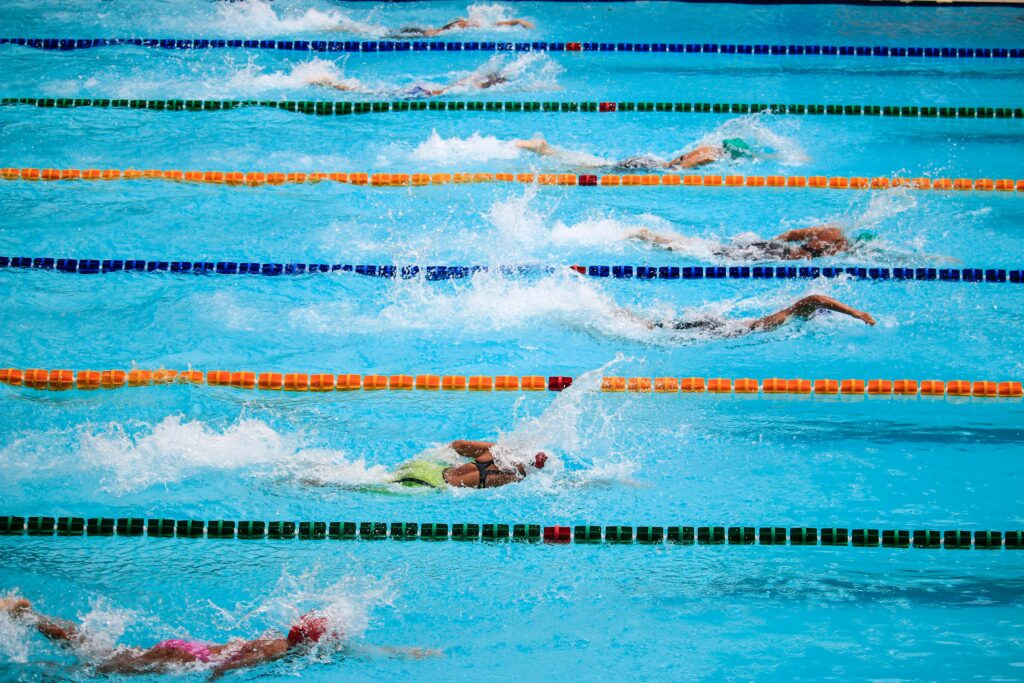
Phase 1: Fast Start (0-100m) Elite swimmers begin at 107-108% of average race velocity. This aggressive opening establishes good positioning and rhythm without creating excessive lactate buildup.
Phase 2: Even Pace (100-1400m) Competitive swimmers maintain velocity close to 100% of average race pace. Swimming velocity remains stable through the middle section with minimal lap-to-lap variation.
Phase 3: End Sprint (1400-1500m) The final phase sees swimmers increase to 104-106% of mean velocity. Winners don’t use dramatically different pacing than other finalists – they simply swim faster overall.
Monitoring Split Times During the Race
Effective split monitoring requires swimmers to track their pace at predetermined checkpoints without disrupting stroke rhythm or technique. Most swimmers check times every 200-400m rather than every lap.
Key Monitoring Points:
- 200m: Confirm opening pace isn’t too aggressive
- 600m: Assess middle-distance rhythm
- 1000m: Check energy reserves for closing phase
- 1300m: Prepare for final acceleration
Swimmers should establish acceptable ranges rather than exact targets. Being 1-2 seconds ahead or behind at 400m allows for natural race flow whilst maintaining overall strategy.
Visual cues help when timing boards aren’t clearly visible. Swimmers can use pool markers, competitor positions, or stroke count to gauge approximate pace when split times aren’t immediately available.
Optimising Stroke Rate and Swimming Velocity
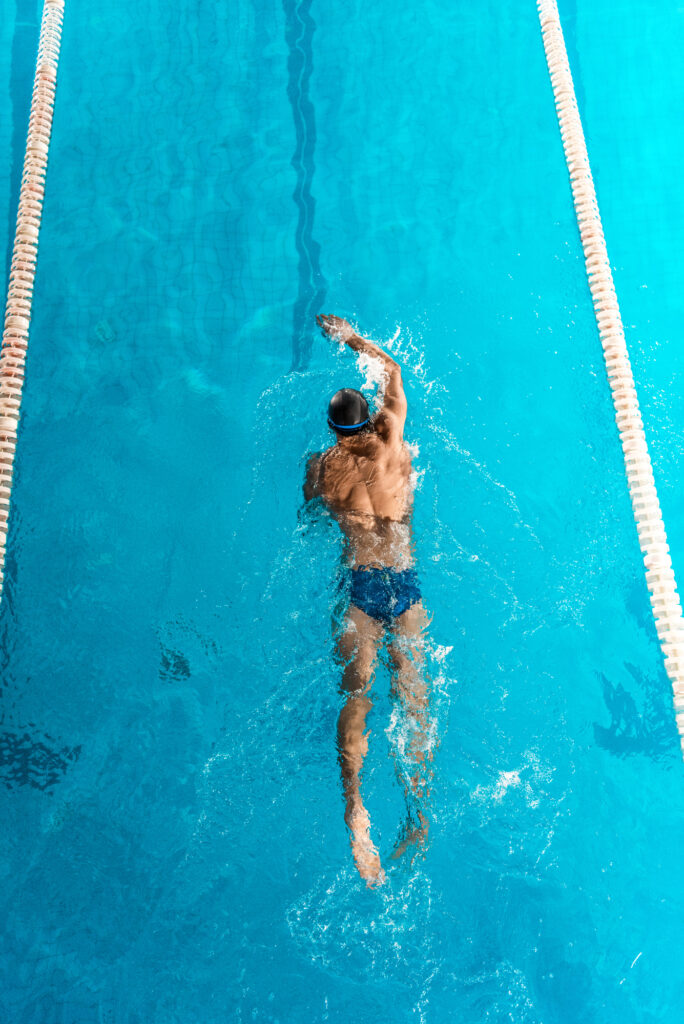
Swimming velocity depends on finding the right stroke rate for each part of the 1500m race. Elite swimmers balance stroke frequency with stroke length to maintain speed whilst conserving energy throughout the distance.
Understanding Stroke Rate in 1500m
Stroke rate measures how many complete arm cycles a swimmer takes per minute. Swimming velocity equals stroke rate multiplied by distance per stroke.
Elite distance swimmers typically use different stroke rates for different race phases. The opening 300m often sees rates of 32-36 strokes per minute. The middle portions drop to 28-32 strokes per minute to conserve energy.
Stroke rate in freestyle swimming varies based on whether swimmers use hip-driven or shoulder-driven techniques. Hip-driven swimmers generally maintain lower stroke rates with longer strokes. Shoulder-driven swimmers use higher rates with shorter, quicker strokes.
Swimmers must determine their optimal rate through testing. Training sets of 7 x 100m freestyle with increasing stroke rates help identify the sweet spot where speed peaks before technique breaks down.
Maintaining Swimming Velocity
Swimming velocity requires balancing stroke rate with stroke length throughout the race. Swimmers cannot simply increase stroke rate to go faster without considering stroke efficiency.
Key velocity factors include:
- Stroke length: Distance covered per stroke cycle
- Stroke frequency: How quickly strokes are completed
- Technical efficiency: Maintaining proper form under fatigue
Elite 1500m swimmers adjust their velocity strategy based on race position and energy reserves. Early race phases prioritise longer strokes with moderate rates. Final 200m often sees increased stroke rates as swimmers access their speed reserves.
Swimmers must avoid the common mistake of dramatically increasing stroke rate when fatigued. This typically reduces stroke length more than it increases frequency, resulting in slower swimming velocity.
Balancing Technique and Speed
Technical efficiency becomes crucial as fatigue accumulates during the 1500m. Swimmers must maintain stroke quality whilst adjusting rate and velocity demands.
Critical balance points:
- Early race: Longer strokes, controlled rates (28-32 spm)
- Mid-race: Consistent technique focus, steady velocity
- Final 300m: Gradual rate increases whilst protecting stroke length
Tempo training using stroke rate devices helps swimmers practise different rates whilst maintaining technique. This develops the ability to shift gears during competition.
Successful 1500m swimmers spend considerable training time at race-specific stroke rates. They practise maintaining technique quality at various velocities to prepare for different race scenarios and tactical situations.
Training and Tools to Improve Race Pacing
Effective pacing develops through specific training methods that simulate race conditions and provide measurable feedback. Race indication workouts help swimmers establish their target pace whilst technology tools track split performance throughout training cycles.
Race Pace Training Workouts
The most effective training for 1500m pacing involves broken swims that replicate race demands. The benchmark workout consists of 1000m, 600m, and 400m swims with five and three minutes recovery respectively.
This workout’s average pace closely matches race pace requirements. Swimmers should aim to maintain consistent splits across all three pieces.
Progressive pace sets build pacing awareness through controlled effort increases:
- 4 x 400m building each 100m (easy, moderate, hard, race pace)
- 6 x 200m at race pace with 30 seconds rest
- 3 x 500m negative split (second half faster)
Time trial sets test pacing control under pressure. Swimmers complete 1500m efforts monthly to track progress and refine their race strategy.
Lactate threshold training improves the body’s ability to maintain race pace. Sets of 8 x 100m or 4 x 200m at threshold pace develop the physiological capacity needed for sustained effort.
Using Pace Calculators and Split Analysis
Digital tools provide precise feedback for pacing development. Swimmers input target race times to generate lap-by-lap splits for training and competition.
Pace calculators break down race times into 50m, 100m, and 200m splits. This allows swimmers to practise hitting specific times during training sets.
Split analysis reveals pacing patterns after each swim. Coaches identify where swimmers lose time and adjust training accordingly.
Tempo trainers provide audio cues for stroke rate consistency. Swimmers programme devices to match their optimal race tempo for different race phases.
Video analysis combined with split times shows technique breakdown at specific paces. This identifies when stroke efficiency deteriorates under fatigue.
Training logs track split progressions over time. Consistent monitoring reveals fitness improvements and pacing strategy effectiveness.
Utilising Short Course Metres for Preparation
Short course metres pools offer unique advantages for pacing preparation despite most major competitions occurring in long course. The increased number of turns provides more split data points for analysis.
Turn frequency in short course develops pacing rhythm through regular feedback points. Swimmers receive split information every 25m rather than 50m intervals.
Training in 25m pools allows coaches to provide more frequent pace guidance. This develops internal pacing awareness more rapidly than long course training alone.
Conversion factors help swimmers translate short course times to long course expectations. Generally, swimmers add 8-12% to their short course times for long course predictions.
Short course pace sets challenge swimmers’ ability to maintain consistent effort despite frequent interruptions. This builds mental toughness for maintaining pace under pressure.
The reduced pool length allows for more precise interval training. Coaches can design sets that target specific energy systems whilst monitoring pace closely.
Frequently Asked Questions
Elite swimmers follow specific patterns for energy distribution and stroke maintenance in 1500m races. Mental focus techniques and proper breathing rhythms become crucial for maintaining pace over the full distance.
What is the ideal strategy for distributing energy in a 1500m freestyle race?
The most effective pacing follows a parabolic or U-shaped pattern. Swimmers should begin with a strong start at 107-108% of their average race velocity.
The middle section requires maintaining an even pace close to 100% of average race velocity. This steady rhythm should last from approximately 50m to 1400m of the race.
Elite swimmers increase velocity above average in the final two laps. The last lap typically reaches 104-106% of mean velocity for optimal performance.
Research shows that making the first two laps slightly slower and the final laps faster could reduce race time by approximately 1.4%. This approach helps conserve energy for the crucial finishing sprint.
How can swimmers maintain consistent lap times throughout a 1500m event?
Lap-to-lap variability should remain minimal throughout the middle section of the race. The coefficient of variation in lap times should stay low between 100m and 1400m.
swimmers achieve consistency by focusing on stroke rate rather than stroke length during the steady-pace phase. Maintaining a rhythm of approximately 30-32 strokes per 50m helps preserve energy.
Regular pace monitoring during training builds the body awareness needed for race day. Swimmers should practise swimming at target pace with split times every 100m or 200m.
Pool positioning can affect consistency. Swimming slightly to one side of the lane centre helps avoid turbulence from adjacent competitors whilst maintaining straight tracking.
What are effective breathing techniques for long-distance freestyle events?
Bilateral breathing every third stroke provides optimal oxygen intake whilst maintaining stroke symmetry. This pattern prevents muscle imbalance over the long distance.
During the middle section, swimmers can establish a comfortable rhythm of breathing every second or third stroke. Consistent oxygen flow prevents early fatigue accumulation.
The breathing pattern may need adjustment during the final sprint. Some swimmers switch to breathing every second stroke during the last 200m to maximise oxygen uptake.
Swimmers should avoid holding their breath or over-breathing, which can disrupt stroke rhythm. Steady exhalation underwater followed by quick inhalation maintains efficiency.
In what way should a swimmer’s stroke change as they progress through the stages of a 1500m race?
The opening 100m requires a longer, more powerful stroke to establish position. Stroke rate increases slightly whilst maintaining good technique fundamentals.
During the main body of the race, stroke length becomes paramount. Swimmers should focus on distance per stroke rather than turnover rate to preserve energy.
The stroke rate gradually increases during the final 300m. This change should happen naturally as pace increases rather than forcing higher turnover.
Maintaining high elbow catch throughout all phases prevents stroke breakdown. Technique deterioration leads to decreased efficiency and wasted energy over the distance.
How important is the role of the initial dive and first length in setting the pace for a 1500m swim?
The start and first 50m establish the swimmer’s position in the field. A strong underwater phase can provide 1-2 body lengths advantage over competitors.
However, swimmers must avoid going out too aggressively in the opening length. Exceeding 110% of target race pace can lead to significant time loss in later stages.
The first 100m split should be approximately 2-3 seconds faster than average 100m pace. This accounts for the dive start whilst avoiding excessive early speed.
Position after the first length influences psychological confidence. Being near the leaders without overexertion provides mental advantages for the remainder of the race.
What mental tactics can help maintain focus and pacing over the course of a 1500m freestyle?
Breaking the race into smaller segments helps maintain concentration. Swimmers can focus on 300m or 400m blocks rather than the full 1500m distance.
Counting strokes or breathing cycles provides mental anchoring during the middle phase. This technique prevents pace drift when physical fatigue increases.
Positive self-talk becomes crucial after 1000m when discomfort increases. Simple phrases like “smooth and strong” help maintain technique under pressure.
Visual cues such as pool markings or lane ropes help maintain straight swimming. Focusing on these references prevents energy waste through poor positioning.
Regular position awareness without panic helps with tactical decisions. Knowing competitor locations allows for strategic moves in the final 400m without wasted effort.