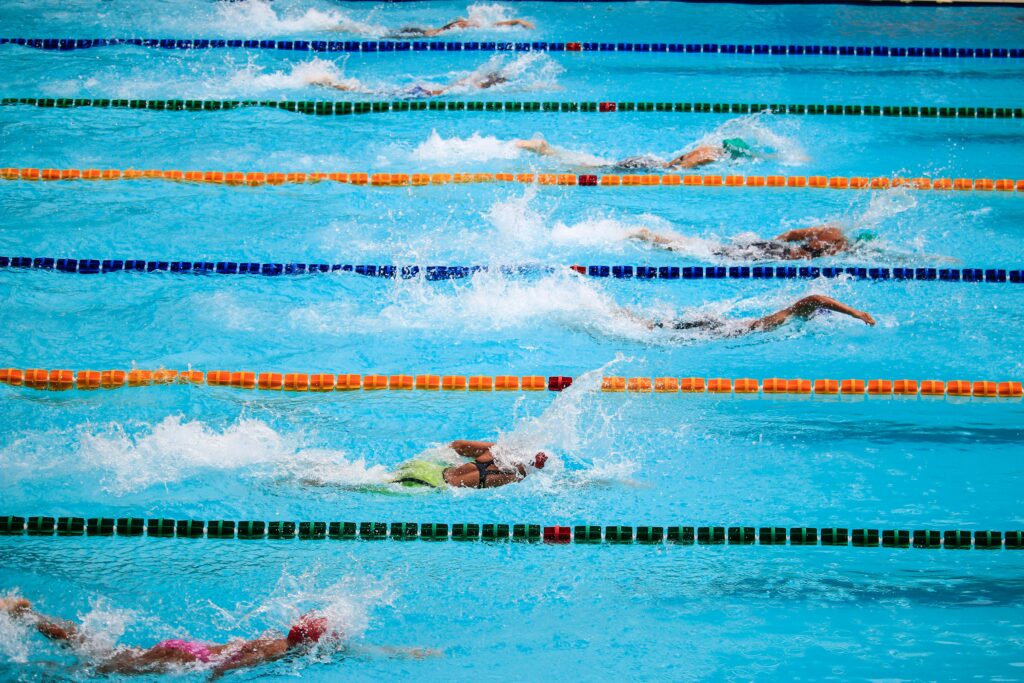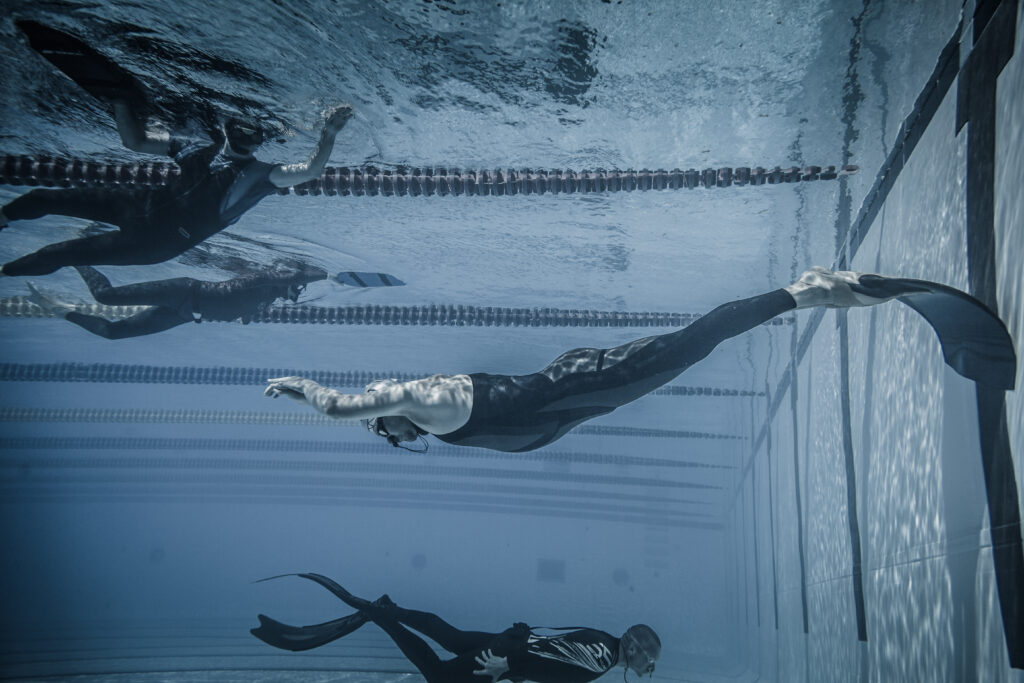

The swimming catch up drill is a freestyle drill where one arm stays stretched out in front while the other arm completes a full pull and recovery, and you only begin the next stroke once the recovering hand taps the waiting hand. That single rule fixes rushed, windmilling arms faster than almost anything else a coach can give you, because it makes an early pull physically impossible.

It is an old-school drill, and it has stuck around for a reason. Coaches use it with eight-year-olds learning front crawl and with Masters swimmers chasing a cleaner catch, and both groups get the same lesson: wait at the front, then pull with purpose.
You will come away knowing how to swim the drill properly, which mistakes quietly cancel out its benefits, and how to slot a short set into your next session. If you want more structured technique work to build around it, our library of swimming drills is a good place to start planning your week.
Perfect the Wait-and-Tag Timing

Good catch-up timing comes down to three things: a long push-off, one complete arm cycle, and a quick tag instead of a lazy float. Get those right and the drill teaches itself.
Start From a Long Streamline
Push off the wall in a tight streamline, face down, both arms extended and your head between your biceps. Start a steady flutter kick before your first stroke.
That kick is what keeps you moving while one arm sits parked out front. Without it, you stall the moment the drill begins.
Keep your head down and your eyes towards the bottom of the pool. Lifting your chin drops your hips and makes the whole drill harder than it needs to be.
Complete One Arm Cycle Before Switching Sides
Pull with one arm only. Catch with a high elbow and fingertips angled down, press under your shoulder, and finish the pull past your hip before recovering over the water.
The other arm stays extended the entire time. The FORM coaching guidance for this drill sums the focus up as head down, high elbows, and pulling under the shoulder.
Only when the recovering hand reaches the front and touches the waiting hand do you switch sides. Many coaches ask swimmers to lead with one arm for a full 25m, then swap.
Keep the Touch Brief Rather Than Pausing
Treat the hand tap as a relay exchange. The fingers meet, and the next pull starts straight away.
A long hold at the front feels productive but creates a dead spot. Your speed drops, your hips sink slightly, and you end up practising a rhythm you will never use in a race.
Breathe every three strokes if you can. Breathing on every single stroke tends to unbalance the drill because your lead arm has nothing to hold against.
What This Drill Improves in Your Freestyle

The payoff shows up in three places: a more patient front end, a steadier body line, and a catch that grips water earlier in the stroke. Those gains carry straight back into normal swimming once you drop the drill.
Build Patience and Distance Per Stroke
Most swimmers who feel choppy in the water are turning their arms over too quickly for the propulsion they are producing. The drill removes that option.
Because the lead arm waits, you feel exactly how far each pull carries you. Count your strokes over a length of drill, then count them again during easy freestyle, and the difference is usually obvious.
A guide from Swim Like A Fish lists patience, distance per stroke and a strong kick linked to a high elbow catch as the three lessons the drill exists to teach.
Use the Lead Arm to Support Balance and Body Position
That extended arm is doing more than waiting. It acts like a keel, holding your body long and narrow while the other side rotates and pulls.
You will notice your hips ride higher when the lead hand stays near the surface. Let it sink and the whole line collapses.
This is also why the drill exposes a weak kick so quickly. There is nowhere to hide when only one arm is working.
Set Up a More Effective Catch
With one arm moving at a time, you have the headspace to feel the start of the pull. Bend at the elbow early, keep the forearm facing backwards, and press water towards your feet.
That shape is the high-elbow catch, sometimes called the early vertical forearm. Rushing the entry is what stops most swimmers from finding it.
Slowing everything down gives you a fraction of a second to set the forearm before you apply force. It is the same principle behind many freestyle technique sessions.
Avoid the Errors That Undermine the Drill

Four faults account for nearly every wasted catch-up length: a sinking lead arm, a hand that crosses the midline, an over-long glide, and a kick that quietly stops. Watch for them and the drill does its job.
Do Not Let the Lead Arm Sink or Cross Over
The extended arm should sit just under the surface, relaxed, with the elbow high and the fingertips pointing forward. A dropped elbow out front teaches the exact position you are trying to unlearn.
Crossing the centre line is the other common fault. Your lead hand should stay in line with your shoulder, not drift across your nose.
Filming a single length on a phone from the poolside tells you more than a hundred lengths of guessing.
Prevent Over-Gliding and Loss of Momentum
Over-gliding is the most frequent mistake in this drill. You wait so long at the front that you slow to a crawl between strokes.
Coaches at Swim Like A Fish teach a “quick touch” version for exactly this reason: the hands connect briefly, then the next pull starts.
If you feel yourself decelerating between strokes, shorten the tag. You should stay in motion the whole length.
Maintain Rotation and a Steady Kick
Rotate through your hips and shoulders on every stroke, the same as normal freestyle. Swimming the drill flat on your chest turns it into an arm exercise with no carryover.
Keep a strong flutter kick going from the push-off to the wall. The gap between strokes is precisely when swimmers let their legs go quiet.
Lower Moreland Swimming head coach Karney McNear told Your Swim Log that the gap between strokes is why the drill works so well for building a full, unrelenting kick.
Choose the Right Variation and Practice Set

Start with equipment support if you need it, then strip it away and tighten the timing until it looks like real freestyle. A handful of 25s or 50s in your warm-up or technique block is plenty.
Use a Kickboard or Fins for Extra Support
Holding a kickboard in the lead hand adds stability and gives you something solid to reach for. Swap arms every 25m so both sides get equal work.
Fins add propulsion, which stops the lead arm stalling while it waits. FORM’s drill levels run from a kickboard, to fins, to no equipment at all.
Use a snorkel if turning to breathe keeps disrupting your rhythm.
Move From Full Catch-Up to Three-Quarter Catch-Up
Once the full version feels natural, shorten the wait. In three-quarter catch-up, the lead arm starts pulling when the recovering hand is about three-quarters of the way forward.
The hands never meet, but one is always extended in front of your head. That is front-quadrant timing, and it is what fast distance swimmers use.
This progression bridges the gap between drill rhythm and race rhythm.
Pair It With a Fist Drill to Improve Feel for the Water
Swim a length of catch-up with closed fists, then open your hands for the next length. Without your palms, you are forced to press with your forearms.
When your hands open again, the water feels thicker. That contrast is the whole point.
Single-arm freestyle works well alongside it too: 25m right arm, 25m left, 25m full catch-up.
Add It to a Freestyle Technique Set
Keep the volume modest. Try this in a warm-up or technique block:
- 4 x 50m catch-up drill, 20 seconds rest
- 4 x 25m catch-up / 25m easy freestyle, carrying the same cues
- 8 x 50m: first 25m three-quarter catch-up, second 25m at race pace
Slot it into a broader plan such as our swim workouts for intermediate swimmers, or use it before pace work like 800m freestyle training sets.
Turn Patient Timing Into Better Freestyle

The catch-up drill earns its place in freestyle swimming by making you wait at the front of the stroke, hold a long body line, and set the forearm before you pull. Those habits show up as fewer strokes per length and a smoother freestyle stroke at full speed.
Keep the tag quick, the kick constant, and the lead elbow high. Use it in short sets of 25s and 50s, then swim normal freestyle straight afterwards while the feeling is fresh.
Count your strokes on one length before the drill and one length after, and track that number across a few weeks. Rising distance per stroke at the same effort is the clearest sign the timing has stuck.
Frequently Asked Questions

What are catch-ups in swimming?
Catch-ups are a freestyle drill where your hands meet in front of your head between every stroke. One arm stays extended while the other completes its pull and recovery, then taps the waiting hand to trigger the next stroke. The name comes from one arm “catching up” to the other.
Is the catch-up drill good for beginners?
Yes, it is one of the most beginner-friendly freestyle drills because it slows everything to one arm at a time. That makes it much easier to feel your arm path, elbow position and timing. It suits Masters swimmers relearning technique just as well, and pairs neatly with swimming drills for beginners.
How do you do a catch-up drill with a kickboard?
Hold one end of a kickboard with your lead hand, arms extended, and swim a normal single-arm pull with the other arm. Touch the board with your recovering hand before swapping over. Swap the leading arm every 25m so both sides get equal practice.
Can you use a pull buoy for the catch-up drill?
You can, and some coaches use a pull buoy version to isolate the arms completely. It removes kick timing from the equation so you can focus on hand entry and the catch. Just be aware you lose the kick-building benefit, which is one of the drill’s strongest features.
Does the catch-up drill make freestyle slower?
The drill itself is slower than normal freestyle, and that is intentional. It is a teaching tool for timing and feel, never a racing stroke, so keep it to short sets and never swim it at race tempo. Move to three-quarter catch-up as your timing improves so the rhythm stays closer to real swimming.
What is the difference between the catch-up drill and the zipper drill?
In the catch-up drill, the recovering hand reaches all the way forward and taps the extended hand before the next pull begins. The zipper drill keeps the recovering hand tracing close along your side, like pulling up a zip. Catch-up trains front-of-stroke patience; the zipper fixes a wide, wasteful recovery.