Swimming progress doesn’t happen by accident. Regular, consistent training is what transforms beginners into skilled swimmers and helps experienced athletes maintain their competitive edge. Whether you’re learning to swim or refining your technique, showing up to practice regularly makes the difference between slow improvement and steady advancement.
Many swimmers wonder why their progress stalls or why certain techniques feel difficult to master. The answer often lies in training frequency. Consistency in swimming practice builds the muscle memory, endurance, and mental resilience that sporadic sessions simply cannot develop. Your body needs regular exposure to swimming movements to adapt and improve.
This article explores why maintaining a consistent swim training schedule matters for your development. You’ll learn how routine practice enhances your physical performance, helps you master proper technique, and keeps you progressing towards your swimming goals.
Key Takeaways
- Regular swim training builds muscle memory, endurance, and the mental toughness needed for long-term improvement
- Consistent practice allows small improvements to compound over time, leading to significant gains in technique and performance
- Establishing a structured routine with clear goals and support systems helps you stay committed and motivated throughout your swimming journey
Why Consistency Matters in Swim Training
Regular participation in swim training creates physiological and psychological adaptations that sporadic sessions simply cannot replicate. Your body and mind require repeated exposure to develop the efficiency, resilience, and conditioning necessary for meaningful progress in the pool.
Building Muscle Memory for Efficient Swimming
Muscle memory develops through repetition, allowing your body to execute swimming movements automatically without conscious effort. When you maintain consistent swim training, your neuromuscular system strengthens the pathways between your brain and muscles, making each stroke more efficient. This process requires frequent practice sessions rather than occasional intensive workouts.
Consistent training reinforces proper stroke mechanics, helping you swim with less wasted energy. Your nervous system learns to fire muscle groups in the correct sequence and timing, whether you’re performing freestyle, backstroke, breaststroke, or butterfly. Without regular practice, these neural pathways weaken, and you’ll need to relearn movements you’ve already mastered.
The quality of your technique improves dramatically when you swim multiple times per week. Errors can be identified and corrected before they become ingrained habits. Inconsistent swimming allows poor form to persist, making corrections more difficult later.
Developing Mental Toughness Through Regular Practice
Mental discipline grows alongside physical conditioning through consistent swimming practice. Regular training sessions mentally condition swimmers by instilling discipline, boosting confidence, and helping you develop strategies to manage pressure. You learn to push through discomfort and fatigue, skills that transfer directly to competitive situations.
Your confidence increases when you know you’ve completed the preparation required for success. Swimmers who attend practice regularly approach races with trust in their training and abilities. This psychological advantage helps you remain calm and focused when performance matters most.
Consistency also teaches you to manage setbacks and plateaus. You develop resilience by showing up even when progress feels slow or motivation wanes. This mental fortitude becomes invaluable during challenging training blocks and competitive seasons.
Minimising Injury Risks with Steady Progression
Gradual, steady training through consistent swim training minimises the risk of overtraining or sudden strain caused by irregular workouts. Your muscles, tendons, and joints adapt to training loads over time, becoming more resilient when exposed to progressive increases in volume and intensity. Sporadic training prevents this adaptation, leaving you vulnerable to injury when you suddenly increase effort.
Your cardiovascular system, muscular endurance, and flexibility all improve through regular exposure to swimming. These adaptations occur gradually and require consistent stimulation to maintain. Long gaps between sessions force your body to start the adaptation process repeatedly, increasing stress on tissues and joints.
Consistency in swimming allows you to monitor your body’s responses and adjust training accordingly. You’ll recognise early warning signs of fatigue or strain, enabling you to modify your programme before minor issues become serious injuries.
Enhancing Physical Performance Through Routine
Regular training sessions create measurable improvements in cardiovascular capacity, technique refinement, and efficiency in the water. Establishing a consistent routine allows your body to adapt progressively whilst reinforcing proper movement patterns.
Building Endurance and Stamina
Your cardiovascular system adapts significantly when you maintain regular swimming sessions throughout the week. Training consistently strengthens your heart and lungs, enabling you to sustain longer distances and more intense efforts without fatigue.
Swimming engages multiple muscle groups simultaneously, requiring substantial oxygen delivery to working tissues. When you practise regularly, your body increases capillary density in muscles and improves oxygen utilisation efficiency. These adaptations occur gradually over weeks and months of consistent training.
Key endurance benefits include:
- Enhanced aerobic capacity for sustained effort
- Improved lactate threshold for faster swimming
- Greater muscular endurance in arms, legs, and core
- Reduced recovery time between training sessions
Missing sessions disrupts this adaptation process. Your body requires continuous stimulus to maintain and build upon previous gains in cardiovascular fitness.
Improving Body Position and Kicking Efficiency
Proper body position reduces drag and allows you to move through water with less resistance. Consistent practice ingrains the correct horizontal alignment, with your head, hips, and feet maintaining a streamlined posture.
Your kick provides propulsion and stability whilst maintaining balance in the water. Regular training develops the hip flexibility and ankle mobility needed for effective kicking. The repetitive motion strengthens your hip flexors, quadriceps, and hamstrings through continuous engagement.
Focus on maintaining a tight core during each session. This connects your upper and lower body movements whilst preventing your hips from dropping. Consistent attention to body position becomes automatic through repeated practice.
Optimising Stroke Rate and Flip Turns
Your stroke rate determines how quickly you move through the water whilst maintaining efficiency. Regular training helps you find the optimal balance between stroke frequency and distance per stroke for your body type and event distance.
Flip turns require precise timing, spatial awareness, and powerful execution. Practising these transitions consistently improves your approach speed, rotation timing, and push-off strength. Each training session provides opportunities to refine these technical elements.
Elements to refine regularly:
- Approach distance and speed adjustment
- Rotation timing and body positioning
- Wall contact and push-off angle
- Streamline position off the wall
Consistent repetition allows you to execute turns automatically during races, maintaining momentum without conscious thought about technique.
Mastering Swimming Technique with Ongoing Practice
Technique refinement happens through repeated exposure to proper movement patterns, while breathing coordination requires dedicated attention to develop natural rhythm in the water.
Refining Stroke Technique Over Time
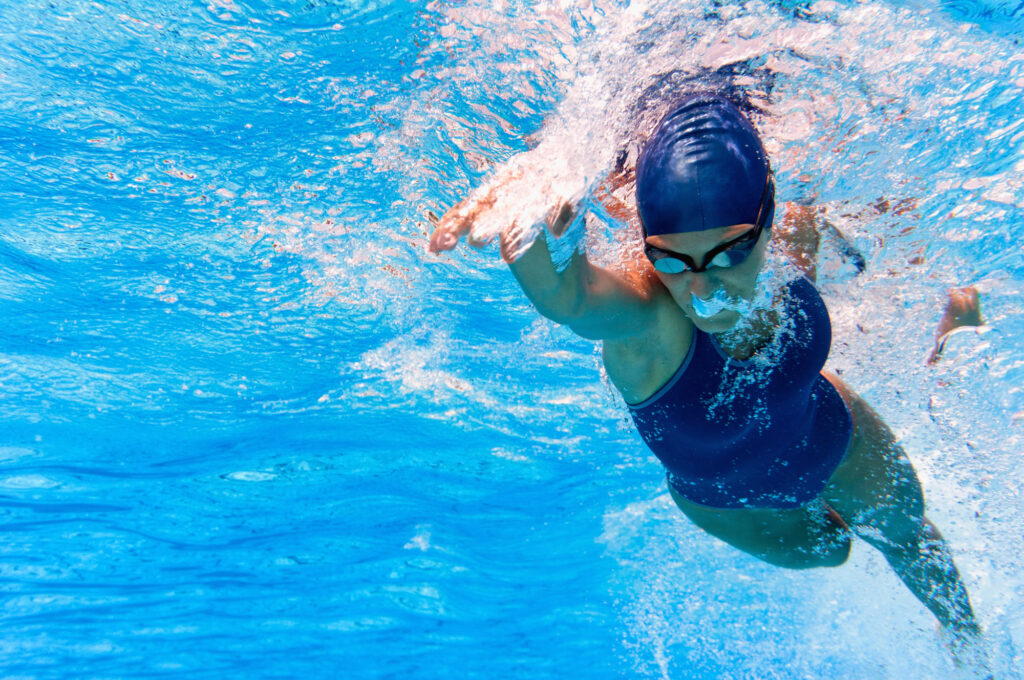
Your stroke mechanics improve incrementally through regular practice sessions that build muscle memory. Each training session allows you to focus on specific elements like hand entry angle, elbow position during the pull phase, and body rotation timing. These technical details become automatic only when you practise them consistently over weeks and months.
Recording your swimming sessions provides valuable feedback for technical adjustments. You can identify issues with your catch phase, streamline position, or kick timing that might not be obvious whilst you’re in the water. Working with drills that isolate particular stroke components helps you address weaknesses systematically.
The repetitive nature of training engrains proper movement patterns into your neuromuscular system. Without consistent reinforcement, these patterns deteriorate and inefficient habits can return. Your stroke technique requires ongoing attention even after you’ve achieved proficiency, as maintaining form demands the same dedication as developing it initially.
Breathing Skills and Rhythm Development
Breathing coordination represents one of the most challenging aspects of swimming technique to master. You need to synchronise your breath timing with your stroke cycle whilst maintaining body position and forward momentum. This skill develops through consistent swim training that builds both technique and endurance.
Your breathing pattern affects your stroke rhythm, rotation timing, and overall efficiency in the water. Practising bilateral breathing helps balance your stroke mechanics and prevents over-rotation to one side. You should focus on exhaling fully underwater to make inhalation quick and efficient during the breathing window.
Regular training allows you to experiment with different breathing patterns for various distances and intensities. Sprint efforts might require fewer breaths per lap, whilst distance swimming needs sustainable breathing rhythms that support aerobic capacity.
Achieving Swimming Goals and Celebrating Milestones
Structured swimming goals provide direction and purpose to your training sessions, while recognising your achievements along the way reinforces commitment and builds lasting motivation in the pool.
Setting Clear, Achievable Goals
Structured goal-setting increases training consistency by giving each session a defined purpose. Break your swimming goals into short-term and long-term objectives to maintain focus across different timeframes.
Short-term targets might include reducing your 100-metre freestyle time by three seconds within four weeks or completing an additional 500 metres during endurance sets. These immediate goals keep you engaged during individual training sessions.
Long-term objectives extend three to six months ahead, such as qualifying for a regional competition or completing your first continuous 2,000-metre swim. Using SMART criteria ensures your goals remain Specific, Measurable, Achievable, Relevant, and Time-bound rather than vague aspirations.
Document both technical and performance targets. Technical goals might focus on perfecting bilateral breathing or improving flip turn efficiency, whilst performance goals centre on speed, distance, or endurance benchmarks.
Tracking Progress for Motivation
Recording swimming data transforms abstract improvements into tangible evidence of your development. Use swimming apps, training logs, or spreadsheets to document times, distances, stroke counts, and technique refinements after each session.
Review your records weekly to identify patterns and trends. You’ll notice gradual improvements that aren’t obvious day-to-day, such as consistent splits across longer distances or reduced stroke counts per lap.
Compare current performance metrics against baseline measurements from previous weeks or months. This retrospective analysis reveals genuine progress even during training plateaus when immediate improvements feel elusive.
Track both quantitative and qualitative measures. Note how you felt during difficult sets, your energy levels throughout training, and specific technique adjustments your coach recommended.
Celebrating Milestones to Boost Commitment
Recognising achievements reinforces positive training behaviours and maintains long-term dedication. Celebrate milestones when you reach weekly attendance targets, achieve personal bests, or master challenging techniques like butterfly stroke.
Create a reward system aligned with your accomplishments. Treat yourself to new goggles or a training gadget after four consecutive weeks of consistent attendance. Plan a special meal or activity when you achieve a significant time improvement.
Share your progress with training partners, coaches, or online swimming communities. Announcing achievements creates accountability and inspires others whilst reinforcing your own commitment to continued improvement.
Acknowledge smaller victories between major milestones. Notice when flip turns feel more fluid, when breathing patterns become more natural, or when difficult sets require less recovery time than previously.
Structuring an Effective Swimming Routine
A properly structured routine requires balancing high-intensity intervals with adequate recovery periods whilst maintaining detailed records of your performance metrics and progress.
Balancing Interval Training and Recovery
Interval training forms the backbone of an effective swimming routine, alternating between periods of intense effort and active rest. This approach builds both speed and endurance more efficiently than steady-pace swimming alone.
Structure your interval sessions by dividing them into clear segments. Begin with a 200-400m warm-up, then move into your main set of intervals—such as 8x100m freestyle with 30 seconds rest between each repetition. The rest periods are crucial as they allow your heart rate to recover partially whilst keeping your muscles engaged.
Building a structured swim routine requires strategic planning to prevent overtraining. Include at least one full rest day per week and consider active recovery sessions of 20-30 minutes at low intensity. These lighter sessions promote blood flow and muscle repair without adding significant fatigue.
Vary your interval distances and intensities throughout the week. Sprint intervals of 50m might target pure speed, whilst 300m intervals develop race-pace endurance. This variation prevents plateaus and reduces injury risk from repetitive strain.
Logging Workouts and Self-Assessment
Tracking your sessions provides objective data about your progress and helps identify patterns in your performance. Record key metrics including total distance, interval times, rest periods, and perceived exertion levels after each workout.
Use a simple notebook, spreadsheet, or dedicated swimming app to log your workouts. Note specific details such as “10x100m freestyle averaging 1:25, felt strong” or “struggled with breathing during backstroke sets“. These observations reveal which areas need attention and which techniques are improving.
Review your logs weekly to assess progress and adjust your training plan accordingly. Compare your current times against previous weeks to measure tangible improvements. If certain intervals consistently feel difficult or your times plateau, this signals the need to modify your approach—either by adding more recovery, adjusting intensity, or incorporating different drills.
Self-assessment extends beyond numbers. Pay attention to how your body responds to training loads, noting any persistent fatigue, soreness, or changes in motivation levels. These indicators help you maintain consistency by preventing burnout and overtraining.
Building Motivation and Support Systems
Training with others and building a support system provides the motivation, accountability, and encouragement needed to maintain regular swimming practice. Group training environments create structure whilst connecting you with swimmers who share similar goals.
Joining a Swim Club or Training Partner Scheme
Joining a swim club delivers immediate structure through scheduled sessions and access to experienced coaches who provide guidance and feedback. Club environments foster camaraderie amongst members, making training sessions more enjoyable and less isolating. You’ll benefit from organised workouts that target specific skills, eliminating the need to plan your own sessions.
Training partners offer similar advantages on a smaller scale. A reliable partner creates mutual accountability, making it harder to skip sessions when someone else depends on your presence. You can push each other during challenging sets and share techniques that have worked well.
Key benefits of structured training include:
- Regular practice times that establish routine
- Access to coaching expertise for technique refinement
- Peer motivation during difficult workouts
- Shared knowledge about training methods
Staying Accountable Through Community
Swimming communities extend beyond the pool, offering support that keeps you motivated through challenging periods. Share your goals with club mates, coaches, or family members who can track your progress and provide encouragement. This external accountability often proves more effective than relying solely on self-discipline.
Many swimmers maintain commitment by discussing their training plans openly with others. When you’ve told your training group about an upcoming goal, you’re more likely to follow through with the necessary preparation. Community members understand the specific challenges of swimming training and offer relevant advice based on their own experiences.
Regular interaction with your swimming community also provides perspective during plateaus. Other swimmers have navigated similar obstacles and can suggest adjustments to your training approach.

Frequently Asked Questions
Regular training sessions build muscle memory and physical conditioning whilst developing the mental discipline needed for peak performance. Swimmers who maintain structured routines experience improvements in technique, endurance, and injury resilience.
How does regular swim training enhance performance over time?
Regular swim training creates muscle memory through repeated practice, which allows you to execute stroke mechanics more efficiently. Your body adapts to the physical demands of swimming, resulting in improved cardiovascular fitness and muscle strength.
Consistent training leads to steady progress through incremental gains that accumulate over weeks and months. You’ll notice improvements in your technique, speed, and stamina after four to six weeks of regular sessions. Within three to six months, significant endurance and strength gains become evident.
The relationship between frequency and adaptation means your body becomes more efficient at processing oxygen and recovering between efforts. This physiological adaptation translates directly to faster times and longer sustainable efforts in the pool.
What role does consistency play in swim training for competition readiness?
Consistency develops the mental toughness required for competition by strengthening your focus, confidence, and resilience. A regular training routine prepares both your body and mind for the pressures of competitive swimming.
Building mental discipline through consistent practice helps you manage pre-race nerves and maintain composure during events. You develop the ability to push through discomfort and fatigue, which proves crucial during close races.
Competition readiness depends on maintaining peak physical condition leading up to events. Gaps in training disrupt this conditioning and require additional time to regain lost fitness. Swimmers who train consistently arrive at competitions with stable performance levels rather than unpredictable results.
Can maintaining a routine in swim training improve stroke technique?
Frequent practice allows you to refine your strokes, turns, and breathing techniques through repetition. Errors can be identified and corrected before they become ingrained habits that prove difficult to change later.
Each training session provides opportunities to focus on specific technical elements. You might dedicate one session to body rotation in backstroke and another to catch mechanics in freestyle. This targeted approach compounds over time.
Muscle memory develops when you repeat proper movements consistently. Your nervous system creates efficient neural pathways that make correct technique feel natural and automatic. Irregular training disrupts this process and forces you to relearn movements rather than refine them.
What are the benefits of a steady training schedule for injury prevention in swimming?
Gradual, steady training minimises the risk of overtraining or sudden strain caused by irregular workouts. Your body adapts progressively to increased demands when you follow a consistent schedule.
A regular routine helps your musculoskeletal system strengthen and adapt to swimming’s repetitive movements. Tendons, ligaments, and muscles develop the resilience needed to handle training loads safely. Sporadic training leaves these tissues vulnerable to injury when you suddenly increase intensity or volume.
Better recovery comes from consistent training as your body learns to repair and rebuild more efficiently. You’ll experience less fatigue and soreness when training becomes part of your regular routine. Rest days scheduled within a consistent plan allow proper recovery whilst maintaining overall fitness.
How frequently should one engage in swim training to see measurable progress?
Beginners should aim for two to three sessions per week before progressing to four to six sessions. This frequency allows adequate recovery whilst building foundational fitness and technique.
The optimal frequency depends on your current fitness level and goals. Recreational swimmers typically benefit from three to four sessions weekly, whilst competitive swimmers often train five to six days per week. Each session should last between 45 minutes and 90 minutes, depending on intensity and objectives.
Measurable progress becomes evident within four to six weeks when you maintain regular training. You’ll notice improvements in your breathing efficiency, stroke count per length, and overall speed. Tracking these metrics helps you identify when adaptations occur and whether your training frequency proves sufficient.
In what ways does consistent swim practice contribute to overall endurance and stamina?
Regular training sessions build cardiovascular capacity by challenging your heart and lungs to deliver oxygen more efficiently. Your aerobic system adapts to sustained efforts, allowing you to maintain higher intensities for longer periods.
Increased endurance develops through consistent practice that progressively overloads your energy systems. Each session slightly stresses your body, prompting adaptations that improve your ability to sustain effort. These adaptations include increased capillary density in muscles and enhanced mitochondrial function.
Stamina improvements manifest as the ability to maintain proper technique throughout longer distances. You’ll find that sets which once left you exhausted become manageable, allowing you to focus on refining form rather than simply surviving the workout. Your lactate threshold increases, meaning you can swim faster before fatigue sets in.