
The 200m individual medley stands as one of swimming’s most demanding events, requiring swimmers to master all four competitive strokes whilst maintaining precise pacing and technique throughout the race. This challenging event tests not only technical skill in butterfly, backstroke, breaststroke, and freestyle, but also demands strategic thinking and exceptional physical conditioning.
The most successful 200m IM swimmers employ specific pacing strategies, with elite performers typically allocating approximately 22% of their race time to butterfly, 25% to backstroke, 29% to breaststroke, and 24% to freestyle. Understanding these proportions helps swimmers develop realistic race plans based on their individual stroke strengths and weaknesses, rather than swimming each leg at maximum effort.
Mastering the 200m individual medley requires comprehensive preparation that extends far beyond simply practising each stroke. From perfecting underwater dolphin kicks and streamline positions to developing stroke-specific endurance and mental resilience, swimmers must approach their training with systematic precision. The following strategies will help competitive swimmers optimise their performance through improved technique, tactical awareness, and race-day preparation.
Understanding the 200m Individual Medley
The 200m individual medley combines all four competitive swimming strokes into one challenging race with specific stroke order requirements. This event tests swimmers’ versatility across butterfly, backstroke, breaststroke, and freestyle whilst demanding strategic pacing different from other individual medley distances.
What Is the Individual Medley?
The individual medley challenges a swimmer’s aquatic prowess, requiring mastery of all four competitive strokes: butterfly, backstroke, breaststroke, and freestyle. Swimmers must demonstrate technical proficiency in each stroke during a single race.
The 200m individual medley consists of 50 metres of each stroke. Each stroke segment represents 25% of the total race distance.
The individual medley is one of the most demanding events in competitive swimming. It requires proficiency in all four strokes and the ability to transition between them smoothly.
Swimmers cannot choose their preferred stroke order. The sequence remains fixed across all individual medley events.
Stroke Order and Race Structure
The 200 individual medley follows a mandatory stroke sequence that never changes:
| Order | Stroke | Distance |
|---|---|---|
| 1st | Butterfly | 50m |
| 2nd | Backstroke | 50m |
| 3rd | Breaststroke | 50m |
| 4th | Freestyle | 50m |
Swimmers begin with butterfly off the starting blocks. The transition to backstroke occurs with a touch turn where swimmers flip onto their backs.
The backstroke-to-breaststroke transition requires swimmers to touch the wall on their back then turn onto their front. The final transition from breaststroke to freestyle allows swimmers to change to front crawl immediately after touching the wall.
Each stroke segment demands different energy systems and techniques. The stroke order creates specific tactical challenges as swimmers manage their energy across varying stroke speeds.
Key Differences Between 100 IM, 200 IM, and 400 IM
The 100 IM covers 25 metres per stroke and prioritises speed over endurance. Swimmers maintain near-sprint pace throughout the race.
The 200 IM requires more strategic pacing with 50 metres per stroke. The 200 metre individual medley, with its fast-paced nature, demands quick thinking and strategic race tactics.
The 400 IM spans 100 metres per stroke, emphasising endurance capacity. The 400 IM requires insane endurance, while the 100 IM is made for swimmers with speed.
Pacing strategies differ significantly between distances:
- 100 IM: Maximum effort throughout
- 200 IM: Controlled speed with strategic surges
- 400 IM: Conservative early pace with negative splitting
Training focus varies by distance. Sprint-based training suits the 100 IM, whilst the 400 IM requires extensive aerobic conditioning.
Optimal Race Strategy for the 200m Individual Medley
Swimming a fast 200m individual medley requires careful pacing through each stroke and smart energy distribution to maintain speed across all four disciplines. The most successful swimmers use negative splitting techniques whilst managing their effort levels to avoid early fatigue that could compromise their final strokes.
Negative Splitting and Pacing
Negative splitting each quarter forms the foundation of smart 200m individual medley strategy. Swimmers should aim to swim the second 25m of each stroke faster than the first 25m.
This approach prevents swimmers from going out too hard on the initial strokes of each 50m segment. Rather than starting at maximum intensity, swimmers build speed gradually through each stroke section.
Effective pacing strategy includes:
- Starting each 50m at 85-90% effort
- Building to 95-100% effort in the final 25m
- Maintaining consistent stroke technique throughout
- Avoiding dramatic pace changes between strokes
The butterfly leg particularly benefits from controlled pacing. Swimmers who attack this opening stroke too aggressively often struggle significantly during the final freestyle section.
Each stroke transition provides an opportunity to reset pacing. Swimmers can use the brief wall contact to mentally prepare for building speed through the next 50m segment.
Energy Management and Easy Speed
Finding easy speed prevents early burnout that destroys performance in the latter stages of the race. This concept involves swimming at the fastest sustainable pace without compromising endurance for the remaining distance.
Breathing patterns play a crucial role in energy management. Swimmers should maintain consistent breathing rhythms they use in training rather than attempting to breathe less frequently during competition.
Key energy conservation techniques:
- Save leg strength during butterfly and backstroke
- Avoid excessive kicking on underwater dolphin phases
- Maintain steady breathing patterns throughout
- Focus on stroke efficiency over raw power
The first 100m requires particular restraint. Swimmers who exhaust their legs early find themselves struggling through breaststroke and freestyle when these strokes demand the most power.
Energy management doesn’t mean swimming slowly. Instead, swimmers learn to distinguish between sustainable speed and unsustainable intensity that leads to rapid fatigue.
Tactical Use of Strengths and Weaknesses
Smart swimmers adjust their race strategy based on their individual stroke strengths and weaknesses. Those with strong butterfly can afford slightly more aggressive early pacing, whilst swimmers with weaker butterfly must be more conservative.
Swimmers should identify their strongest and weakest strokes during training. This knowledge allows them to compensate strategically during competition.
Strategic approaches by stroke strength:
- Strong butterfly: Can push slightly harder early whilst maintaining good position
- Weak butterfly: Must focus on technique and minimal energy loss
- Strong freestyle: Can afford to be more conservative through middle strokes
- Weak breaststroke: Should build extra speed in backstroke to maintain momentum
Race position also influences tactical decisions. Swimmers trailing the field might need to take more risks with aggressive pacing, whilst those leading can focus on maintaining their advantage through controlled swimming.
The 200m individual medley rewards swimmers who can maintain their technique under fatigue. Those who practise swimming all strokes whilst tired will have significant tactical advantages during competition.
Mastering Transitions and Turns
The fastest 200m IM swimmers excel at crossover transition techniques and maximise their underwater phases with powerful dolphin kicks. These skills can reduce lap times by several seconds compared to basic open turns and weak streamlines.
Crossover Turn Techniques
The crossover turn transforms the backstroke-to-breaststroke transition from the slowest changeover into a competitive advantage. Most elite swimmers now use this technique because it offers three distinct benefits over traditional methods.
Timing and Vision Advantages Unlike open turns where swimmers reach back blindly, the crossover transition allows swimmers to see the wall before touching it. This visual contact enables precise timing and eliminates guesswork.
The technique also extends reach distance. Swimmers can stretch further overhead whilst on their side compared to reaching straight back.
Mechanical Efficiency The crossover follows the law of inertia better than other methods. Rather than reversing direction completely, swimmers maintain forward momentum through the turn.
This creates faster transitions compared to:
- Open turns: Slower and require complete direction reversal
- Reverse flips: Disorienting and risk water entering sinuses
- Bucket turns: Cumbersome with legs swinging above water
Learning Requirements The technique demands significant practice time. Swimmers typically need 100 repetitions minimum before attempting it in competition. Those learning with both arms require approximately 500 practice attempts.
The non-dominant arm always takes longer to master than the dominant side.

Streamlines and Underwater Dolphin Kick
Underwater phases after each turn provide crucial opportunities to gain speed and distance. Strong streamlines and dolphin kicks often determine race outcomes in close competitions.
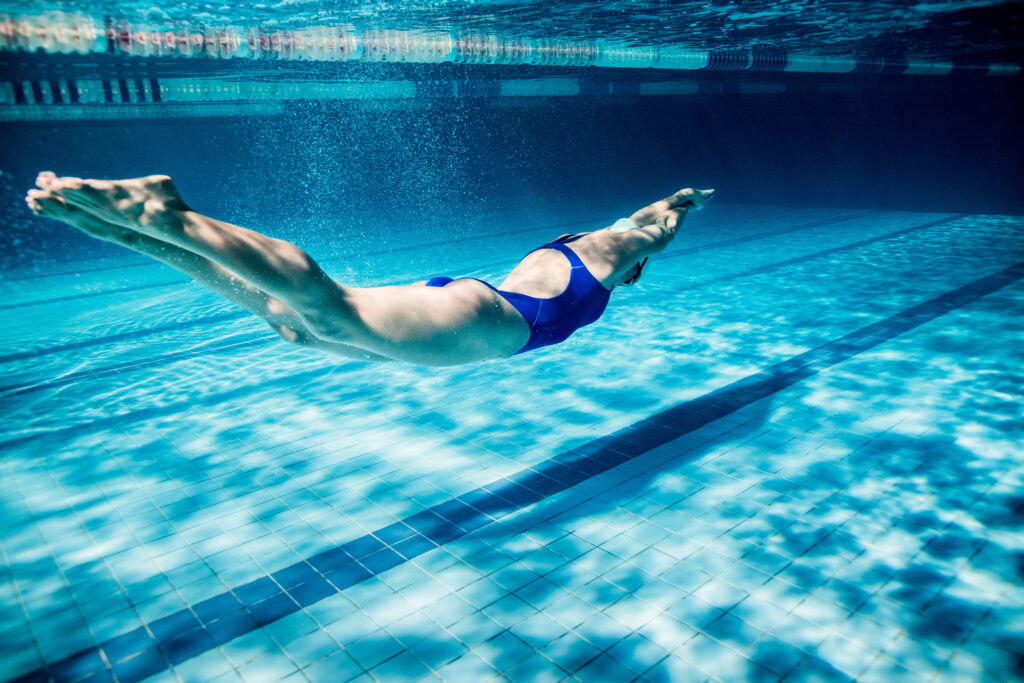
Streamline Position Swimmers must achieve tight body alignment with arms extended overhead. The head stays neutral between the arms whilst core muscles engage to prevent hip drop.
Proper streamline reduces drag significantly compared to loose body positions. Even small gaps between arms or bent wrists create resistance.
Dolphin Kick Technique The underwater dolphin kick generates propulsion through coordinated body waves. Movement initiates from the core and transfers through the hips to the legs.
Swimmers should maintain steady rhythm rather than explosive single kicks. Consistent tempo produces more distance per kick cycle.
Strategic Application Each stroke transition allows maximum 15 metres underwater distance. Swimmers must balance underwater speed against surfacing timing for the next stroke.
Strong kickers often stay underwater longer after butterfly and backstroke legs. Weaker kickers might surface earlier to begin their stronger surface strokes.
The final freestyle leg typically features shorter underwater phases to establish stroke rhythm quickly for the sprint finish.
Stroke-Specific Tactics and Technique
Each stroke in the 200m individual medley requires distinct technical approaches and tactical decisions that directly impact race performance. Mastering breathing patterns in butterfly, maintaining speed through backstroke, optimising power in breaststroke, and executing a strong freestyle finish are essential components for competitive success.
Butterfly: Breathing Patterns and Efficiency
The butterfly leg sets the foundation for the entire race, making efficient technique crucial for success. Swimmers must establish a sustainable breathing pattern that balances oxygen intake with stroke rhythm.
Optimal breathing occurs every second stroke for most swimmers during the 200m distance. This pattern maintains body position whilst providing adequate oxygen. Elite swimmers often breathe every third stroke during the first 25m to establish speed, then shift to every second stroke.
The key technical focus involves keeping the head low during breathing. The chin should barely clear the water surface. High head position creates drag and disrupts the body’s undulation.
Body undulation must remain consistent throughout the leg. The chest drives down as the hands enter, creating the wave motion that propels the swimmer forward. Integrating targeted stroke technique work during training helps maintain this efficiency under race conditions.
Arm recovery should stay relaxed and low over the water. Tense shoulders waste energy and slow stroke rate. The hands enter shoulder-width apart with thumbs pointing down.
Backstroke: Maintaining Speed and Position
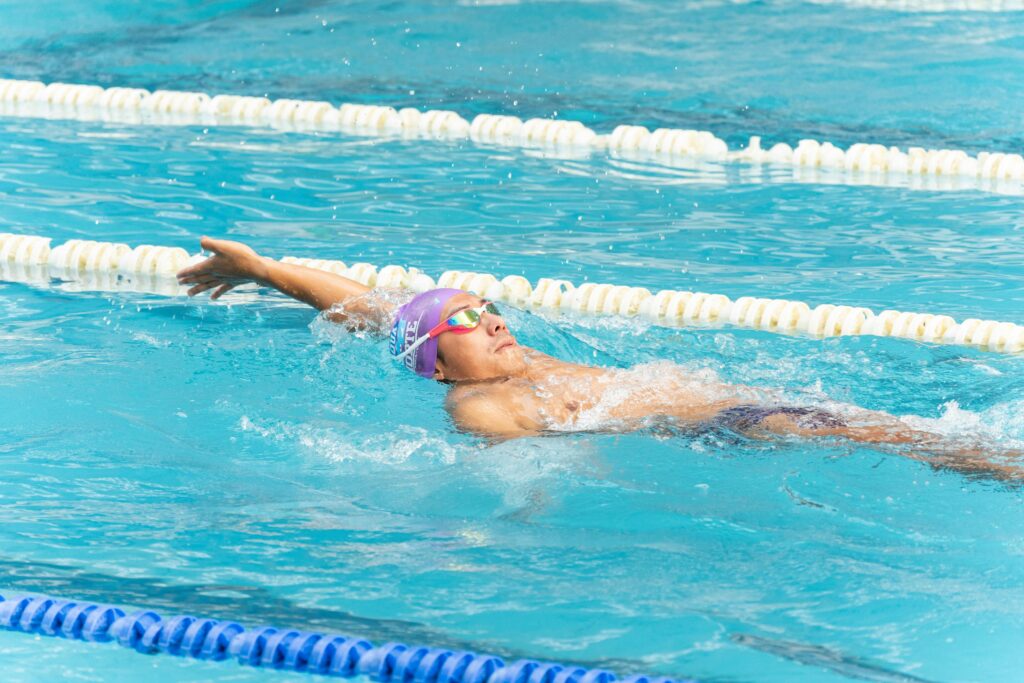
Backstroke presents unique challenges in maintaining speed whilst staying in lane position. The stroke requires consistent rhythm and proper body rotation to generate power effectively.
Body rotation reaches 30 degrees on each side during the stroke cycle. This rotation engages the larger back muscles and creates a longer stroke. Flat swimming reduces power and increases fatigue.
Hand entry occurs directly over the shoulder with the pinky finger first. The catch phase involves pressing water backward rather than downward. High elbow position underwater maximises propulsion throughout the pull.
Lane positioning becomes critical since swimmers cannot see the lane lines clearly. Counting strokes helps gauge distance to the wall. Most swimmers take 7-9 strokes per 25m depending on height and technique.
The flip turn requires precise timing and technique. Swimmers must touch the wall whilst remaining on their back before initiating the turn. Illegal turns result in disqualification, making proper technique essential.
Maintaining stroke rate throughout the 50m leg prevents the common mistake of settling into a comfortable but slow rhythm.
Breaststroke: Power and Timing
Breaststroke technique centres on the timing relationship between arm pull, breathing, and kick phases. This coordination determines both speed and efficiency throughout the stroke cycle.
The 3-2-1 timing pattern provides the foundation for effective breaststroke. Pull for three counts, breathe and recover arms for two counts, then kick for one powerful count. This sequence maximises propulsion whilst maintaining legal stroke technique.
The kick generates 60-70% of forward propulsion in breaststroke. The feet turn outward during the power phase, creating maximum surface area against the water. The kick snaps together quickly rather than gradually closing.
Arm pull occurs in a heart-shaped pattern underwater. Hands sweep outward, then inward toward the chest. The pull remains underwater throughout – lifting hands above water surface violates competition rules.
Streamline position holds critical importance during the glide phase. Arms extend forward as the kick completes, allowing the swimmer to ride the momentum. Premature arm movement reduces efficiency.
The stroke requires maintaining narrow kick width to minimise drag. Wide kicks create resistance and slow forward progress.
Freestyle: Sprint Finish Execution
The freestyle leg functions as the anchor, requiring tactical decisions about when to begin the final sprint. Swimmers must balance energy conservation with maintaining competitive position.
High stroke rate becomes essential during the final 50m. Elite swimmers increase to 90-100 strokes per minute during the finish. This requires months of specific sprint training to execute without technique breakdown.
Breathing patterns shift toward the sprint finish. Swimmers reduce breathing frequency during the final 25m, often taking only 2-3 breaths total. Bilateral breathing helps maintain stroke balance throughout the earlier portion of the leg.
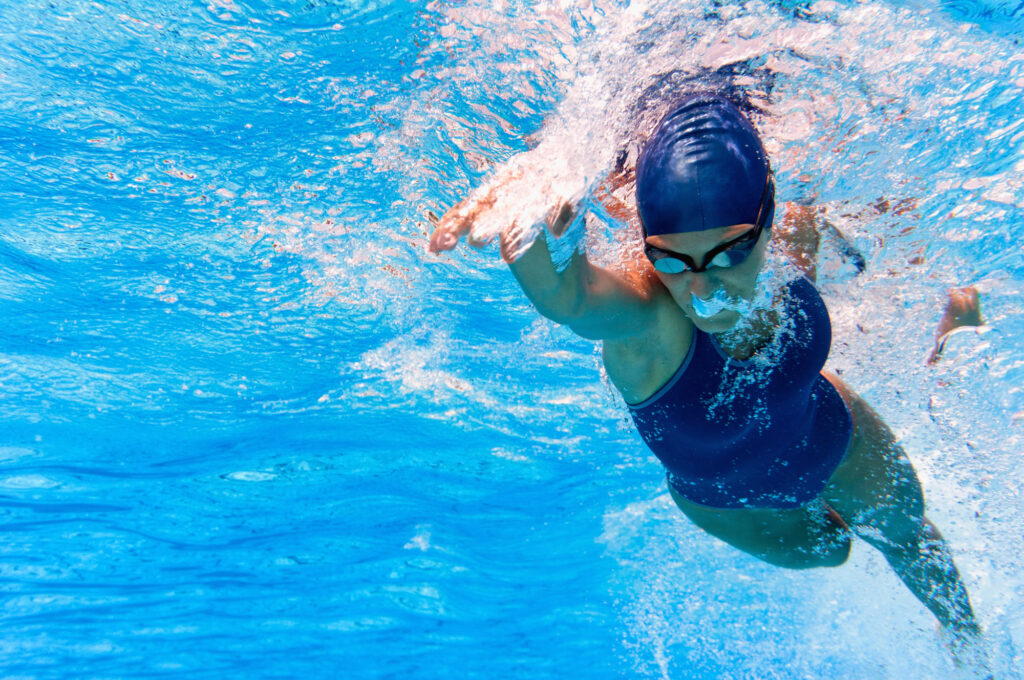
The catch and pull phases require maximum efficiency under fatigue. The hand enters with slight finger separation, catching water immediately. The pull follows a straight-line path beneath the body rather than an S-curve pattern.
Body rotation continues at 45 degrees even during sprint pace. This rotation prevents the stroke from becoming arm-dominant and maintains power generation from core muscles.
Kick intensity increases during the final 25m. The six-beat kick provides maximum propulsion for the finish, though it requires significant energy expenditure.
Building Endurance, Strength, and Versatility
Successful 200m IM swimmers need balanced training sessions that target all four strokes equally, complemented by targeted dryland work and proper recovery protocols. This comprehensive approach develops the physical foundation required for competitive IM racing.
Balanced IM Training Sessions
Training sessions must address both aerobic endurance and stroke-specific strength across all four swimming strokes. Individual medley swimmers need proficiency in butterfly, backstroke, breaststroke, and freestyle to excel in competition.
Effective weekly training includes three key components:
Stroke-Specific Sets
- 4 × 50m of each stroke at race pace
- 8 × 25m stroke transitions focusing on technique
- 200m builds progressing through IM order
Endurance Development
- 3 × 200m IM at descending pace (rest 45 seconds)
- 400m-800m continuous swimming mixing strokes
- Aerobic base building through longer swim sets
Versatility Training
- Mixed stroke combinations (butterfly-breaststroke, backstroke-freestyle)
- Kick sets progressing through all four stroke kicks
- Underwater dolphin kick development for transitions
Training frequency should include 4-5 pool sessions weekly. Each session targets different energy systems whilst maintaining stroke technique across all four disciplines.
Dryland Training for IM Swimmers
Dryland training develops functional strength that directly transfers to improved swimming performance. IM swimmers require balanced muscle development to handle the demands of four different stroke patterns.
Upper Body Strength
- Pull-ups and lat pulldowns for backstroke and freestyle power
- Medicine ball throws for explosive butterfly starts
- Resistance band exercises mimicking stroke patterns
Core Stability
- Plank variations holding for 60-90 seconds
- Russian twists with weighted medicine balls
- Dead bugs focusing on maintaining neutral spine
Lower Body Power
- Squat jumps for explosive push-offs from walls
- Single-leg Romanian deadlifts for kick strength
- Calf raises supporting breaststroke and dolphin kicks
Sessions should last 30-45 minutes, performed 2-3 times weekly. Focus on movement quality rather than maximum weight to prevent injury whilst building swimming-specific strength patterns.
Improving Flexibility and Recovery
Flexibility directly impacts stroke efficiency and injury prevention across all four swimming strokes. Recovery protocols ensure consistent training quality throughout the weekly schedule.
Daily Flexibility Routine
- Shoulder circles and arm swings before training
- Hip flexor stretches targeting breaststroke range of motion
- Ankle flexibility work supporting all kick patterns
Recovery Protocols
- Cool-down swims of 200-400m easy pace after intense sessions
- Foam rolling targeting shoulders, lats, and hip flexors
- Adequate sleep (8-9 hours nightly) for muscle repair
Stroke-Specific Stretches
- Butterfly: chest stretches and thoracic spine mobility
- Backstroke: shoulder external rotation stretches
- Breaststroke: adductor and ankle dorsiflexion work
- Freestyle: lat stretches and hip flexor mobility
Recovery nutrition includes protein within 30 minutes post-training and consistent hydration throughout the day. Active recovery sessions with easy 20-30 minute swims promote blood flow whilst allowing muscle repair.
IM Training Tools and Advanced Practices
Strategic training equipment and modern technology can accelerate IM development whilst studying elite techniques provides proven race tactics. Digital tracking systems help swimmers measure progress across all four strokes.
Using Paddles and Equipment Effectively
Paddles build stroke-specific strength for each IM segment. They increase water resistance and force swimmers to develop proper catch mechanics.
Butterfly paddles should be medium-sized to avoid shoulder strain. Large paddles create excessive load during the demanding first leg of the race.
Backstroke training benefits from finger paddles. These smaller tools improve hand positioning without disrupting stroke rhythm.
Pull buoys isolate arm strength during IM training variations. Swimmers can focus on upper body power without leg fatigue.
Fins help maintain body position during technique work. They’re particularly useful for butterfly and breaststroke training sets.
Training progression:
- Week 1-2: Short sets with paddles (4×50m)
- Week 3-4: Medium sets (6×100m IM)
- Week 5+: Race-pace sets with equipment
Resistance cords and parachutes develop race-specific power. These tools simulate the increased effort needed during competitive racing conditions.
Tracking Progress with Digital Tools
Digital apps measure stroke count, split times, and technique metrics. The MySwimPro app provides structured IM training plans with personalised workouts.
Key metrics to track:
- Split times for each 50m segment
- Stroke count per length
- Underwater distance off each wall
- Turn speed between strokes
Video analysis reveals technique flaws across all four strokes. Swimmers can record underwater footage to study body position and timing.
Heart rate monitors track training intensity during IM sets. This data helps swimmers maintain proper pacing during race preparation.
Weekly tracking schedule:
- Monday: Technique videos
- Wednesday: Split time analysis
- Friday: Stroke count measurement
Smart watches with swimming modes automatically detect stroke changes. They provide real-time feedback during IM training sessions.
Digital logbooks help swimmers identify patterns in performance. Coaches can adjust training based on objective data rather than subjective feedback.
Learning from Elite Swimmers
Elite swimmers demonstrate optimal race tactics and stroke technique. Katinka Hosszú’s race strategy shows controlled pacing through the first 100m followed by aggressive finishing.
Hosszú’s 200m IM approach:
- Conservative butterfly leg (save energy)
- Steady backstroke with strong underwaters
- Controlled breaststroke build
- Explosive freestyle finish
Study race videos to analyse stroke transitions and wall techniques. Elite swimmers demonstrate minimal time spent on walls during turns.
Professional swimmers maintain consistent stroke rates across all four segments. They avoid dramatic pace changes that waste energy.
Elite training patterns:
- High-volume stroke-specific work
- Regular race-pace IM sets
- Extensive underwater training
- Technical refinement sessions
World-class athletes separate butterfly and IM training sessions. This prevents early fatigue from affecting other stroke development.
Elite swimmers practice race scenarios during training. They simulate different competitive situations to prepare tactical responses.
Mental preparation techniques from top performers include visualisation and race-plan rehearsal. These methods improve race execution under pressure.
Preparation for Competition and Mental Focus
Proper mental preparation significantly impacts 200m IM performance by reducing anxiety and enhancing stroke execution. Race day visualisation combined with structured meet preparation helps swimmers maintain focus across all four strokes.
Swim Meet Readiness
Swimmers should arrive at the swim meet with a clear warm-up routine that mimics their training pattern. This routine should include 15-20 minutes of easy swimming followed by stroke-specific drills for each IM stroke.
Pre-race preparation checklist:
- Complete technical warm-up for all four strokes
- Practice underwater dolphin kicks off each wall
- Perform 2-3 build swims at race pace
- Review stroke counts for each 50m segment
Mental preparation plays an essential role in competitive swimming performance by enhancing focus and reducing anxiety. Swimmers benefit from establishing consistent pre-race routines that calm nerves and prepare the body.
The final 30 minutes before racing should focus on relaxation techniques. Deep breathing exercises help maintain composure whilst light stretching keeps muscles loose.
Swimmers should review their race strategy one final time. This includes pacing plans for each stroke and specific technical cues for smooth transitions.
Race Day Visualisation and Goal Setting
Effective visualisation involves mentally rehearsing each stroke transition and pacing strategy. Swimmers should visualise maintaining proper stroke technique even when fatigue sets in during the freestyle leg.
Key visualisation elements:
- Butterfly: Maintaining rhythm and breathing pattern
- Backstroke: Consistent stroke rate and wall approach
- Breaststroke: Timing of pull, breathe, kick sequence
- Freestyle: Building speed whilst maintaining technique
The swimmer mindset plays a crucial role in competitive settings through mental strategies that improve focus and confidence. Goal setting should include both time-based and technical objectives.
Swimmers should establish three types of goals: process goals focusing on stroke technique, performance goals targeting specific times, and outcome goals related to race placement.
Positive self-talk helps maintain confidence throughout the race. Phrases like “strong catch” or “smooth transition” reinforce proper technique under pressure.
Mental rehearsal should include handling unexpected situations such as difficult turns or losing stroke rhythm. This preparation builds race adaptability.
Frequently Asked Questions
Swimmers often face specific challenges when training for and racing the 200m individual medley. The following questions address crucial technical, tactical, and preparation aspects that directly impact race performance.
What are the most effective techniques for transitions between strokes in a 200m individual medley?
Smooth transitions between strokes require precise timing and technique at each turn. The butterfly to backstroke transition involves touching with both hands simultaneously before rolling onto the back in one fluid motion.
The backstroke to breaststroke transition demands swimmers maintain their back position until touching the wall with one hand. They must then execute a quick flip to position themselves for the breaststroke push-off.
The breaststroke to freestyle transition allows swimmers to touch with one hand only. This creates the fastest transition opportunity since swimmers can begin their freestyle stroke immediately after pushing off the wall.
Practising these transitions repeatedly during training helps swimmers develop muscle memory. Training the individual medley requires mastering these challenging transitions alongside stroke technique.
How should one pace themselves during a 200m individual medley to maximise performance?
Elite swimmers follow a specific pacing strategy that maximises their strengths whilst managing energy efficiently. Race pacing analysis shows world record holders swim butterfly at approximately 21.8% of their total race time.
Backstroke typically accounts for 25.1% of the total race time. Swimmers should build speed gradually during this leg rather than maintaining a steady pace throughout.
Breaststroke represents the longest portion at 29.0% of total race time. This stroke often determines race outcomes since fatigue levels are highest during this phase.
Freestyle comprises 24.1% of the race time. Swimmers must reserve enough energy to sprint this final 50 metres whilst maintaining proper technique under fatigue.
The key involves swimming butterfly nearly flat out, building both backstroke and breaststroke so the second 25 metres is faster than the first, then sprinting the freestyle leg.
What are the key elements of a successful training programme for the 200m individual medley?
Individual medley training requires incorporating all four strokes into daily practice sessions. Swimmers need proficiency in each stroke’s 100-metre distance to build the foundation for 200m success.
Training should address both strengths and weaknesses across all strokes. Swimmers must identify their weakest stroke and dedicate additional practice time to improvement whilst maintaining their strongest strokes.
Endurance and speed work must be balanced throughout the programme. Some sessions focus on building aerobic capacity whilst others develop anaerobic power and sprint speed.
Technical work on starts, turns, and underwater phases deserves dedicated attention. These elements can significantly impact overall race times when executed properly.
Progressive overload principles apply to IM training. Swimmers should gradually increase training intensity and volume whilst allowing adequate recovery between sessions.
Which strength and conditioning exercises best complement 200m individual medley preparation?
Core strength exercises form the foundation of IM-specific conditioning. Planks, Russian twists, and medicine ball rotations develop the stability needed for efficient stroke technique.
Pull-up variations target the latissimus dorsi and rhomboids crucial for butterfly and freestyle strokes. These exercises should emphasise both strength and muscular endurance.
Shoulder stability exercises prevent injury whilst improving stroke efficiency. External rotation exercises using resistance bands help maintain healthy shoulder mechanics under training stress.
Leg strength exercises support powerful push-offs and kick patterns. Squats, lunges, and calf raises develop the lower body power needed for strong walls and efficient kicking.
Plyometric exercises improve explosive power for starts and turns. Box jumps, medicine ball throws, and bounding exercises enhance the rapid force production required in competitive swimming.
How can a swimmer improve their turns and underwater phases for a 200m individual medley?
Turn technique varies between each stroke transition and requires specific practice. Swimmers should practise approach speed, wall contact, and push-off direction for each unique turn type.
Underwater dolphin kick strength determines how far swimmers can travel efficiently beneath the surface. Regular kick sets using fins and without fins develop this crucial skill.
Streamline position must be perfected to minimise drag during underwater phases. Arms should be locked overhead with hands overlapping and body held in a straight line.
Timing the breakout point optimally balances underwater speed with surface swimming efficiency. Swimmers should surface when their underwater speed drops below their surface swimming speed.
Practising turns and underwater work separately allows focused improvement. Swimmers can use turn sets and underwater distance sets to develop these skills systematically.
What nutritional strategies support optimal performance in the 200m individual medley?
Carbohydrate intake before training and competition provides the primary fuel for high-intensity swimming. Swimmers should consume 3-5 grams per kilogram of body weight daily during heavy training periods.
Protein consumption supports muscle recovery and adaptation following intense training sessions. Aim for 1.6-2.2 grams per kilogram of body weight spread throughout the day.
Hydration status directly affects performance in anaerobic events like the 200m IM. Swimmers should monitor urine colour and drink fluid regularly throughout training days.
Pre-race nutrition timing influences energy availability during competition. Consuming easily digestible carbohydrates 1-3 hours before racing optimises fuel stores without causing digestive discomfort.
Post-training recovery nutrition accelerates adaptation and preparation for subsequent sessions. Consuming protein and carbohydrates within 30 minutes after training maximises recovery benefits.